 Safeguarding
 Find a church
 Find clergy
 Donate
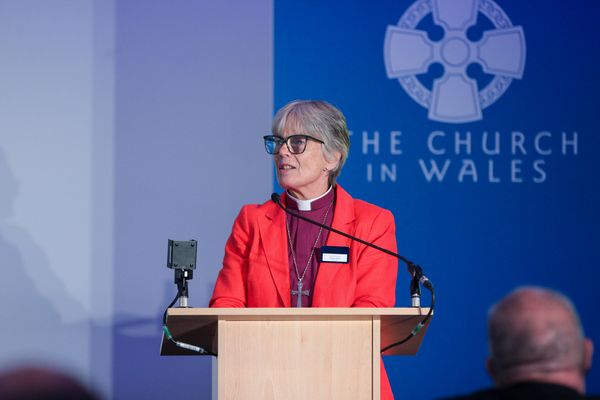
Drawing on the example of the early Christian communities described in the Acts of the Apostles, The Most Reverend Cherry Vann encourages the Church in Wales to renew its commitment to unity, generosity, discipleship, and mission.
The address explores the challenges and opportunities of living as a people "of one heart and soul" in today's complex and divided world. The Archbishop calls the Church to renew its commitment to prayer, generosity, discipleship, evangelism, and mutual support, urging Christians to embody the transformative love of Christ through the way they live together and serve others. As the Governing Body considers a range of important issues, she encourages members to use the values of unity, sharing, dignity, and faithful witness as a guide for the Church's life and future mission.
What follows is the full text of the Archbishop's address:
I want to take you back 2,000 years to the very beginnings of the Christian Church and invite you to imagine yourself in the scene that I’m about to describe. I know some people find this easier to do than others, but as I read, try and place yourself in the story and imagine what it’s like to be there.
‘They devoted themselves to the apostles’ teaching and fellowship, to the breaking of bread and the prayers. Awe came upon everyone, because many wonders and signs were being done by the apostles. All who believed were together and had all things in common; they would sell their possessions and goods and distribute the proceeds to all as any had need. Day by day, as they spent much time together in the temple, they broke bread at home and ate their food with glad and generous hearts, praising God and having the goodwill of all the people, And day by day the Lord added to their number those who were being saved.’ (Acts 2: 42-end)
You’ll no doubt recognise that very familiar passage as coming from the end of chapter 2 of the Acts of the Apostles. It describes some key principles of discipleship and community that lay at the heart of the church’s life and being in those earliest of days. I don’t know about you but whenever I hear or read that passage, I find it immensely challenging. It describes a community of people who devoted themselves to prayer and fellowship, learning and growing as they
allowed themselves to be shaped by the apostles’ teaching. We’re told that they were together. That they spent much time together and they ate together with glad and generous hearts. It describes a vibrant and God-centred community, praising God in the temple and breaking bread together in their homes. Such was their sense of oneness and togetherness that they were moved by faith to hold all things in common- going as far as to sell their possessions and their goods and sharing the proceeds so that no-one went without. No-one remained in need.
This was and is a radically different way of living. And people noticed. The passage tells us that awe came upon everyone as they saw rich and poor living in community together, supporting and helping one another in such a selfless and generous way, and they marvelled at the wonders and signs that they saw the apostles doing.
Two chapters later, following the healing of the blind man at the gates of the temple and some powerful speeches made by Peter to the crowd and to the religious authorities, we’re taken back to a description of what lay at the heart of this extraordinary and newly-formed community:
‘Now the whole group of those who believed were of one heart and soul (not mind, note, but soul) and no one claimed private ownership of any possessions, but everything they owned was held in common. With great power the apostles gave their testimony to the resurrection of the Lord Jesus and great grace was upon them all. There was not a needy person among them, for as many as owned lands or houses sold them and brought the proceeds of what was sold. They laid it at the apostles’ feet and it was distributed to each as any had need.’ (Acts 4:32-35)
Two millennia have passed since then and the church has grown and spread across the entire planet. Leaders have had to develop ways of maintaining unity, order and good governance across huge geographical areas; in different contexts and in different countries. They’ve had to work out how to agree on what is true and faithful to the person and work of Jesus Christ and then find ways of dealing with difference and disagreements, as well as with schisms and heresies. The church has in a vast majority of cases become an institution, having to navigate its place in an ever-changing world amidst ever-increasing complexities. And sadly, since those early days described in the Acts of the Apostles,
the church of God has fractured and split many times. There is now a vast array of denominations; each seeking to be faithful to the gospel; each in their different ways shaped by their understanding of scripture and tradition, as they see it. There are now roughly 45,000 different Christian denominations across the world with the main branches being Roman Catholic, Anglican, Protestant or non-Conformist, Orthodox and Independent. Even within our own denomination of Anglicanism there’s an enormous breadth of different expressions of faith and life.
We can’t go back to what seems now (at least to me at times) a blissfully simple way of living out our faith and discipleship; of being the body of Christ; of being the church. But we cannot and must not lose sight of the principles of Christian living set out in those early stories recorded in our scriptures. The passages from Acts that I’ve read out this morning describe the kind of lives those first disciples were motivated to live because of their faith in who Jesus was and what Jesus had done. They describe a pattern of life that was radically different to the surrounding neighbourhoods; so different that people noticed, commented and were awestruck. And although in some ways, that way of living and being sound very simple and straightforward, it is extraordinarily challenging. Perhaps it was to them in 1st century Palestine. But it certainly is to us, two centuries on.
We do, of course, seek to devote ourselves to growing, learning and praying together, to fostering our fellowship in Christ and to sharing in the breaking of bread. But if we’re honest with ourselves, there are tensions even in these basic and fundamentally important elements of our life together. Being one is a given. That’s our gift in Christ. As St Paul reminds the church in Galatia that was already made up of peoples and groups who wouldn’t normally associate with one another, ‘There is no longer Jew or Greek, slave or free, there is no longer male and female’. All human distinctions have been broken down, ‘for all of you are one in Christ Jesus…heirs according to the promise.’ (Gal 3:28, 29)
But learning how to live that out, discovering what it means to look beyond ourselves and our own differences and disagreements to the one who calls each one of us, sanctifies and redeems us, is much harder. But that is what Christ commands us – to love one another as he loves us and to find our unity in him, even in all our diversity. And when
we catch a glimpse of that unity and can start to rejoice in that unity, then it’s a gift not just to us but to and for the world.
All who believed were together, and had all things in common. Again, something that sounds so simple, but is in fact incredibly challenging. I was talking to a couple of people the other day from a church in my diocese who were telling me that it is still the case that people in their church have a sense of ownership of the pew they sit in and are offended when someone else chooses to sit there. Others have their window and woe betide anyone else who puts flowers on the sill. We might laugh. But those kinds of attitudes are still around in our churches. One wonders what such people understand their faith in Christ to mean.
But start talking about money and probably most of us in this room can understand the temptation to be possessive and to hold on to what we’ve got, be that as individuals, families or church communities. At the heart of our understanding of Ministry/Mission Areas and LMAs is the idea of sharing. Sharing in worship by joining together with others in their church building. Sharing the clergy and LLMs, as they work together as ministry teams across the Ministry Areas for the benefit of all. Sharing in a common life as they are bound together, not just by faith, but legally in governance and through a shared vision of living out their faith in their communities. And sharing resources – again, not just people’s time and talents, not just the teapots and the kettles, but the money. The intention, certainly in the Harris report, is for the money across the churches to be pooled and distributed in a way that supports all the churches of MA.
As we know, right from childhood, all kinds of natural human instincts are triggered when it comes to sharing and learning to share. It’s part of our journey into Christian discipleship to discover what it means to become open and generous rather than defensive and self-protective. What is fair? What is equitable? How can we learn to let go and sit lightly to our possessions and our goods so we can find the freedom in Christ to share what we have? Because our faith teaches us that what we have is a gift, not to be owned or grasped, but to be shared and used to further the work of the kingdom.
We are, as the Church in Wales, an institution, and it’s difficult to imagine how else we could order and govern ourselves as a province; made up
as we are of local churches, MAs and dioceses. The institution provides a vital framework to hold us all together as a provincial family. But we are not a business. We have to be business-like, of course, and we’ve benefitted enormously from the wisdom and practice of secular businesses and organisations, particularly over the last 30 years or more. We’ve been able to follow best practice in things like safe-guarding, HR and communications and we continue to learn how to grow and develop into the best we can be so that the Church in Wales can flourish across this land. But essentially, we are not a business.
Neither are we a branch of Social Services. We’re called to serve and to care, of course. Embedded in the Anglican Communion’s five marks of mission is the call to respond to human need by loving service. Foodbanks, coffee mornings, luncheon clubs and warm hubs are all important ways of living out the love of God in our communities. Work in our schools, our care and residential homes, partnering with our civic and political leaders, joining with other organisations to make a positive difference in our communities, all make up the warp and weft of our life as followers of Jesus.
But Jesus didn’t commission us to go out and solve all the world’s problems. He commissioned us to go and make disciples; to share and live out the good news of Jesus in such a way that others are drawn to him and come to know his saving love for themselves. Yes, our work out there in the communities is important. But our primary task – our primary task - is to share the good news of Jesus Christ. Because knowing Jesus is life-changing. That’s what transforms people’s lives; as we have discovered and continue to discover as we journey together in faith. And that is the gift, the treasure we have to offer the world as God uses us to shine with the light of his love.
We do this by the way we live. We can talk about Jesus, preach about Jesus, teach about Jesus all we like, but if our life together doesn’t reflect that radical transformation then it all risks sounding pretty hollow, like the noisy gong and clanging cymbal Paul speaks of in his wonderful testimony to love in chapter 13 of his first letter to the church in Corinth.
We are to be salt, light and leaven, making a difference in the communities in which God has placed us, living in a way that is
distinctive and remarkable, being the body of Christ that demonstrates mutual support and interdependence.
Amongst the many papers that come through my door every weekend is the Tablet; the Roman Catholic international magazine. An article in one of the August editions of that magazine describes very powerfully what leaven is and does and therefore what effect the church is called to have in the world. The context of the article was the church in Palestine/Israel, which was why it was particularly striking. and the author was a Jesuit priest; son of German Jews and born in South Africa. He contrasts the images of conquest and leaven in reflecting on Christian vocation. Conquest speaks of power, control and victory over what we see as opposing forces. Leaven, however, suggests transformation through integration rather than domination. Being leaven, the author suggests, is a programme of action. It means resisting the temptation to stay safe: looking inward, separating ourselves from others as a reaction to fear and building alliances in the hope of being victorious. Rather, it means dying to self and self-interest so that the risen life of the resurrected Jesus can shine through us and change the world.
Salt of the earth. Light of the world. Leaven in the communities in which we live and work. Here to make a difference, precisely because of how we live together as Christians.
In the next few days, we have the opportunity to reflect more practically on what this means in relation to a number of significant matters that are on our agenda.
In relation to the far right and how we respond well to those who would seek to interpret our faith in way that demonises and excludes others. (Item 14)
In relation to education and our work in schools; ensuring that our children understand the radical nature of our faith and the difference knowing Christ can make to individuals and communities. (Item 7)
Our discussion on the RB paper gives us a wonderful opportunity to find ways of holding on to those values described in the passages of Acts as together we seek to discern how best to steward the God-given
resources we have to support the work of the church. The values of togetherness, sharing and mutual support. (Item 9)
Similarly, the contribution on the work of the USPG will remind us of the importance of those values in embracing and supporting the poorest and most threatened communities, not just in Wales and the UK, but across the world. We are one with them, children of the same heavenly father, no less than we are one with each other, here in this room. (Item 8)
Our work tomorrow on the dignity charter and the accompanying training package will enable and equip us all, at every level of our church’s life to treat one another with proper respect and to live out more effectively that radical lifestyle we read about in the Acts of the Apostles. (Item 13)
And the session on the Pioneer and Evangelism network will take us right back and explicitly into the heart of who we are and what we are called to do. (Item 15)
In it all, let those passages from Acts be for us a template, a standard, a pattern and an aspiration.
‘Now the whole group of those who believed were of one heart and soul, and no one claimed private ownership of any possessions but everything they owned was held in common.’
May God bless our time together and kindle in us the desire to live as one, for the sake of the church and the world we are called to serve.
The Most Reverend Cherry Vann, Archbishop of Wales