
 Safeguarding
 Find a church
 Find clergy
 Donate
The Governing Body met for its Ordinary Meeting on Wednesday, 15 April and Thursday, 16 April 2026 in Llandudno. The meeting was live-streamed and you can read the summary and watch each session below.
Daily Sessions
Session One
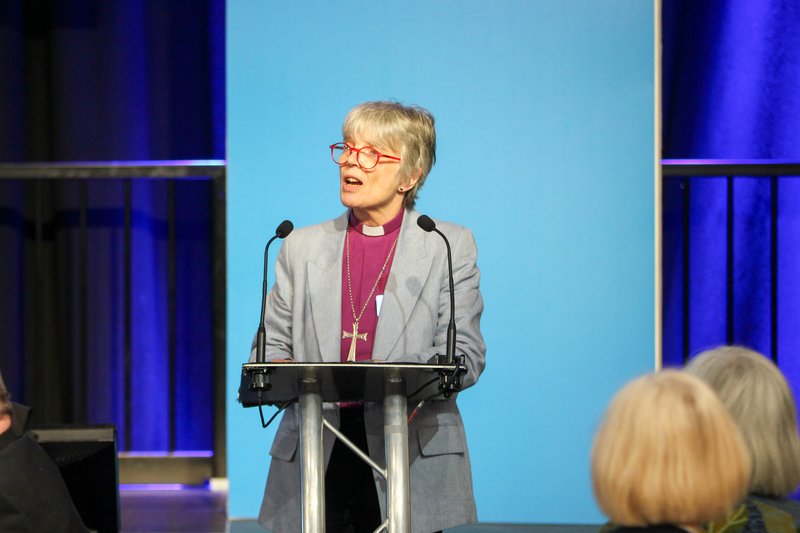
Presidential address
The Archbishop of Wales, the Most Revd Cherry Vann, began her presidential address by urging members of the Governing Body to approach this gathering in a spirit of joyful Easter celebration. “We gather as an Easter people with Alleluia as our song,” she said, but always aware of how Christians elsewhere have had to mark the festival amid war, destruction, fear, and grief, in places such as Ukraine, South Sudan, Iran and across the Gulf, and the Holy Land. Many felt closer to Good Friday than Easter Sunday, she said, praising those in the Church in Wales who were offering financial support, advocacy, solidarity, and prayer.
In Wales too, the impact of rising prices and economic turbulence were being felt, which made the Church’s social action and outreach even more vital, Archbishop Cherry said. “Without social action, our Easter message rings hollow,” she warned.
The upcoming Senedd election would be monumental, as the parliament expanded and 16-year-olds were able to vote for the first time. Christians can and would vote for any of the parties in good conscience, but she urged members to consider how their faith must shape their political engagement. Values such as care for the widows, orphans and strangers, loving our neighbours, and looking beyond self-interest to the common good must be top of mind, she added.
She’d regularly spoken to people who were anxious about their own futures and feared they were not really wanted within the Church, from both evangelical and catholic traditions. If there was fear within the Church, it was because Welsh Anglicans had not yet learned to love each other well enough, as “perfect love casts out fear”, she said. This went beyond niceness, to genuinely wanting the best for each other.
“But we don’t love one another,’ Archbishop Cherry said. “Certainly not as Jesus commanded us. There’s a tendency to try and score points, to play out our own little wars, to seek our own interests rather than those of our sisters and brothers in Christ.” There needed to be greater humility, to acknowledge we may be wrong, to disagree with each other while still loving. Only then can the Church truly be the body of Christ in Wales.
The Governing Body then broke into small groups to discuss Archbishop Cherry’s address before feeding back some comments. Tony Mullins (Llandaff) said churches should be encouraged to hold hustings ahead of the Senedd election, and also asked if the Church could make its own TV programmes to present Christian values to the nation.
Speaking in Welsh, Cynan Llwyd, General Secretary of Cytun, said he was thankful for an 'extremely powerful and substantial address'. He said his table group had been asking how can we love each other better, and how important it was to be friends in Gospel-based prayer. It was very difficult to fall out with someone if you've just been on your knees worshipping the Lord Jesus together.
The Revd Stephen Brett (St Davids) said the Church had both helped and hurt vulnerable people, and asked how could it “square that circle” to restore trust inside and outside the Church. “Does our common life make the resurrection credible?”
The Revd Emma Dale (St Asaph) noted the conflict in the Middle East would mean rising fuel prices and shortages, and asked if the Church had a strategy to “practically assist our communities”.
The Archdeacon of St Asaph, the Ven Andy Grimwood, said his table wondered what were the boundaries on the body of Christ, and what place the traditional formularies in the Church like the Ordinal or Thirty-Nine Articles now had.
Heather Payne (Llandaff) said churchpeople often forgot to live out the Five Marks of Mission. Can those in the Church see the face of Jesus in those they disagreed with, she asked.
The Revd Geraint John (Llandaff) said the Church needed to be vulnerable with one another, and allow itself to be loved.
In response, Archbishop Cherry said there were no easy answers, but backed the idea of hosting hustings as long as they could be properly managed and created space to listen. She also reflected on her own experience living through the debate over women’s ordination during her ministry in Manchester, and the deep division that prompted within the diocese. It had been vital to continue to meet with those who disagreed with her, she said, to “live out the unity we believed we already had in Christ, even though it was so hard to acknowledge”. “I know this works, but it is blooming hard work – we can only do it because we know it is what Christ is asking of us.”
Replying to Archdeacon Andy, she said a desire to follow Jesus was what defined the Church. People should be taken at their word if they said they were a Christian, she added – it was not for us to determine who was in or out.
Session Two
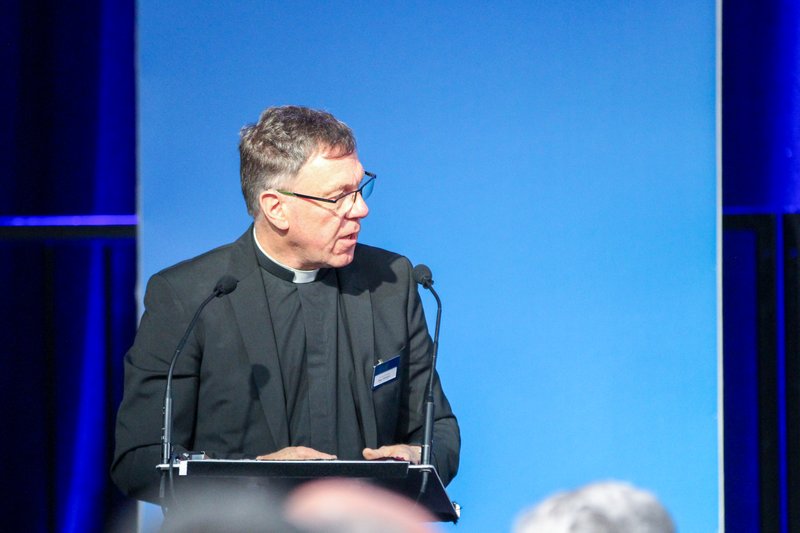
Representative Body report
The Dean of St Asaph, the Very Revd Nigel Williams, deputy chair of the Representative Body, introduced the RB’s report. He first proposed a motion to clarify the Church’s ethical investment policy, to ensure AI systems could comprehend it as they were playing a larger role in investment management. No substantive changes to the restrictions in the policy would be made.
Carrie White (Bangor) asked if the policy prohibited investment in firms utilising aggressive tax avoidance. Dean Nigel said there was currently no mention of this in the policy, but said it would be debated by the investment committee.
The proposal was then passed.
Dean Nigel also informed members an outside review of the RB’s pay structure had been completed, which had prompted a major reform of how staff were paid. Salary progression would now be dependent on performance and not be automatic. These reforms would save the RB money, he added.
A working party was being set up to consider the question of how to hold senior leaders to account in the church. Dean Nigel also addressed a major project in response to a GB motion from last year, which had asked the RB to explore whether it would be possible to restore the RB’s financial contributions to local ministry costs prior to the reforms of the Rowe-Beddoe report in 2005. In summary, the answer was ‘No’, he said. “The RB cannot increase support to ministry areas while maintaining the Church Growth Fund.” However the RB’s spending must always match the Church’s “wants and needs”, and so a consultation with ministry areas was underway to form concrete proposals.
The RB has agreed to take on completely the cost of insurance across the Church, at the sum of £2.6m, releasing ministry areas from paying any premiums themselves. There was a “generational” opportunity to grapple with the finances of the Church in Wales, Dean Williams said, to ensure the RB’s income benefitted the whole Church.
The Archdeacon Missioner in the Diocese of St Davids, the Ven Mones Farah, who brought the original motion about RB funding, said intergenerational equity of faith should take priority over intergenerational equity of finance. Many clergy felt they were reduced to being fundraisers to pay ministry share, and were too exhausted to think creatively about sharing the gospel. The Church in Wales’s membership was declining about 5% a year, Archdeacon Mones noted, which meant a declining income. He suggested releasing 7% of the RB’s funds to help.
Nigel Evans (St Davids) said his church had to choose between spending its money on fixing its leaking roof or its ministry share. Everyone agreed on the importance of generosity from congregants, so could the RB be equally generous with its resources?
Elizabeth Crawford (Monmouth) praised the RB’s work as “extremely welcome and long overdue”. She asked about the church’s unfunded pension scheme, and how much money was being spent on St Padarn’s.
Arwel Davies (St Davids) asked whether existing Tier 2 bids to the Church Growth Fund would be affected by changes in funding from the RB, including one from his diocese which had been in the works for many months.
Speaking in Welsh, he said: "I fully understand the need to review costs. But I think there's an important point here in terms of fairness and maintaining confidence in the processes that the church itself has asked us to do."
Bob Evans (Monmouth) praised the Church for its honesty in producing reports on issues such as Anthony Pierce or the Diocese of Bangor, but said it was less good at following up on these. Could the RB find a way to bring some general lessons learned back to the GB?
Archdeacon Andy questioned whether the Church’s number one priority was still evangelism and mission, and what criteria there were for church growth. He was also concerned the RB seemed to be making decisions without first getting approval from the GB.
The Revd Richard Wood (Bangor) said it was clear what the future Church in Wales would look like: “Very, very small with crumbling infrastructure and buildings.” Any Christian community which was not able to sustain within itself its ministry was no longer viable, from ministry area up to province. This discussion seemed to be about trying to maintain this scenario for as long as possible, he cautioned. To pay long-term reserves into parishes to keep this going for longer would be “absolutely ridiculous”.
The Revd Melanie Prince (St Davids) thanked the RB for their help in taking on insurance, but questioned why only three of the dioceses so far had successful Tier Two grants from the Church Growth Fund. Did the other dioceses fail to apply, or were their applications turned down?
Chris Dearden (Bangor) was concerned that money set aside for growth might now be used to “hold the line”.
The Revd Ruth Rowan (Llandaff) wanted plenty of lay involvement in the consultation on how the Church spends its money.
The Revd Andrew Lightbown (Monmouth) asked what proportion of funds went to the poorest communities across Wales. How can the Church support its least resilient communities, rural and urban, in places were “models just don’t mean anything”? Throw the metrics out of the window and “get on with it”, he urged.
Anthony Appleton (St Asaph) critiqued the pause in Church Growth Fund applications, which was squandering valuable momentum. This must be resolved speedily so projects long in the making could move forward.
In response, Dean Nigel said the RB was keen to consult widely on the “Church of the future”, including with those at the grassroots. But the Growth Fund could not be kept at its original £100m level if the RB was to also support ministry areas, he insisted. Decisions had to be made. On the pension scheme, he said this had been confirmed as lawful by lawyers and the regulator, and was being regularly reviewed by the trustees and actuaries. While an unfunded scheme may sound risky, it was actually well in hand, he said, as the RB held more than enough assets. Setting up a funded pension scheme would cost more, leaving less money to distribute to the wider Church. He said the review of St Padarn’s had been discussed by the bishops, and a working group set up to implement its recommendations.
The Growth Fund had been paused, so any bids approved would be honoured but other projects still to be considered were on hold, he added. It would be up to the Church to take the decision on where priorities lay on future funding, through the GB and standing committee. “All of us must look beyond our own vested interest,” Dean Nigel concluded. “There are many worthy applications, but we need to decide how we want to resource the Church in the future. There is one cake and it can only be sliced into so many slices.”
Members voted to approve the RB’s report.
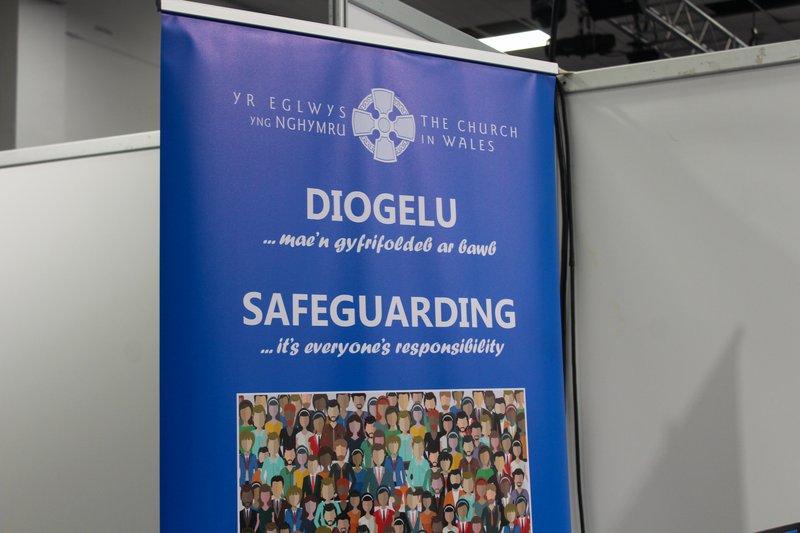
Safeguarding update
Ant Griffiths, the provincial director of safeguarding, said three years ago at his last update to the GB there was a need for big improvements in Church safeguarding: better governance and leadership, and more consistency. Three years on, the Church was still experiencing these issues, Mr Griffiths said: “We have not made sufficient progress, and that progress is too slow.” The safeguarding team could not fix this by themselves, it needed a whole Church approach. “Safeguarding is everybody’s responsibility.”
Casework had expanded significantly, with the team now recording about 50 cases a month, a five-fold increase since Mr Griffiths began in 2021. There were currently 148 open cases, and 59 safeguarding agreements or risk management plans in place across the province. But this was a “success story”, he added; it showed people were better at recognising harm and abuse and responding to it. “The more you know, the more you see.”
However, his team needed more resources to enable it to not just reactively deal with the casework, but be proactive in preventing abuse and supporting parishes. Each year the provincial safeguarding team trained about 2,000 people, Mr Griffiths also reported, and there was room for growth here too.
Proposals to strengthen safeguarding had been recently discussed by the RB and standing committee, because the team was still finding “obstacles” and “resistance” in embedding good safeguarding culture. Could GB members use their leadership and influence in the Church to champion safeguarding and encourage people to speak up, he asked. Too often, compliance was overlooked and people not held to account when they failed to follow procedure (such as around safer recruitment).
Archdeacon Mones asked if the rise in safeguarding cases was due to present-day issues or uncovering historic cases. Mr Griffiths said it was a mixture of both.
Sue Rivers (Llandaff) asked if people were not taking up training because they had already received comparable training for their roles outside of the Church. Mr Griffiths said the main issue was with lay church officers not attending their training. But church training was unique and therefore necessary even if you had been trained elsewhere.
Cathryn Brooker (Monmouth) said she had been extensively trained in safeguarding through her work with Girlguiding, and it was frustrating to have to go “over and over” the same things in other training. “Please can we work together!” Mr Griffiths said he wished organisations could harmonise training, but the Church was bound by its regulators to train people independently.
Other speakers raised similar issues around the different types of DBS checks and repetition of training, noting this was hampering the cultural shift in compliance Mr Griffiths had raised.
Session Three and Four

Same-sex blessings
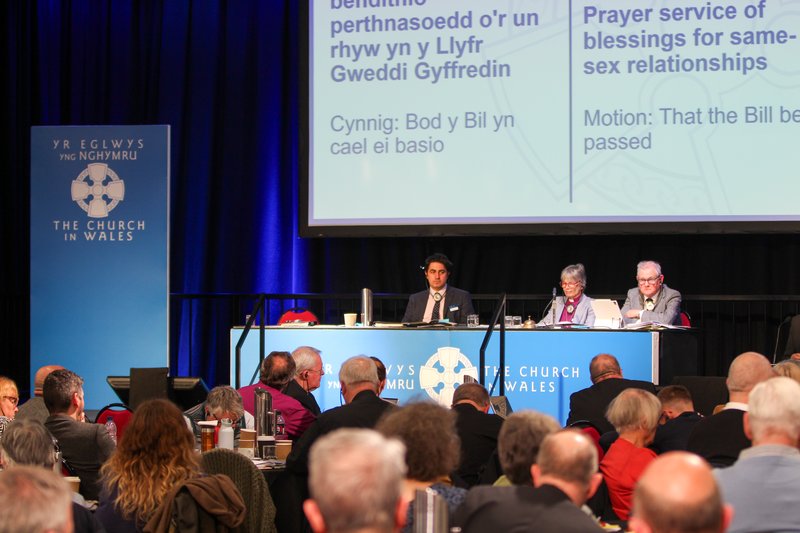
Speaking from the chair before the debate began, Archbishop Cherry said the tone of the discussion mattered as much as what was said. “All who speak this afternoon will be doing so out of deep conviction and a love for God, his church and its mission. Many in this room, whether they are for or against the bill, are likely to be hurt and challenged by what they hear others say about them, their faith and their relationships. Let us listen and speak in a spirit of love and humility.”
Before the debate began, a procedural motion from two members was moved to hold the vote by secret ballot. Mr Wood said while he was unafraid to express his thoughts, other members felt under pressure about how to vote. His motion would help ensure the final vote was a true representation of the GB’s views.
The Assistant Archdeacon of Brecon, the Ven Mark Clavier, spoke to second the motion. He could see strengths on both sides of the debate, but believed any vote such as this, touching on conscience matters, must be as free from external pressure as possible.
Tim Llewellyn (St Davids) opposed the motion, arguing that anyone elected or co-opted must be prepared to defend the way they had voted openly and did not want to set a precedent for the future.
The Revd Dr Sue Hurrell (co-opted) believed similarly, that all members must be accountable for what they decide.
The Archdeacon of the Gwent Valleys, the Ven Stella Bailey, said all Christians must be honest about the convictions they hold. Without this honesty, how can relationships be open and truthful? Voting in secret would be no better than retreating into siloes: “Let our yes be yes, and our no be no.”
Mr Lightbown said it would be unimaginable for any other legislative body to cover up their decisions by voting in private. If elected, all members should be prepared to have to explain how they voted. To do otherwise would be “moral cowardice”, he argued.
Isaac Olding (Swansea and Brecon) backed the motion, suggesting some members may not be sure where they stood and unsure how to vote.
Hannah Rowan (co-opted) said those speaking in good faith according to their conscience should have no fear of doing so openly. If this felt difficult, then it might be a sign that one’s conscience was not settled on it. LGBT people like her did not have the “luxury of hiding”.
The Revd Kevin Ellis (Bangor) supported the motion, believing it was regrettably necessary.
Archdeacon Mones said open voting on highly contentious issues could twist outcomes, as “social pressure and hierarchies can change behaviour”. People might feel pressure to vote for what it easiest to maintain relationships than what they truly believed. The secret ballot was necessary to produce truth rather than performance, he said.
Ms Rowan was saddened the GB had become so fearful of disagreement that a secret ballot could even be considered. “If we don’t know one another, we can’t love one another.”
Della Nelson (Llandaff) said she had felt alienation as a result of being open about her views, so supported creating a “safe space” for people on all sides to vote without marginalisation.
Canon Adam Pawley (St Asaph) said if the motion would not have been brought forward if there were no members afraid of openly voting their convictions, and therefore was by definition necessary.
The motion was defeated 57-43, with two abstentions.
The GB then went into committee stage, with the Archdeacon of Margam, the Ven Mark Preece, who chaired the bill’s select committee, introduced its report. He said the committee was keen to seek God’s blessing same-sex couples, but would add a conscience clause for those who could not support the rite.
A series of minor drafting amendments, some clarifying which elements of the liturgy were optional, were proposed by Archdeacon Mark and carried.
Ms Nelson then brought two amendments, unsupported by the committee, to replace the word “covenant” in the liturgy with “promise”, worrying it would otherwise impinge on the doctrine of marriage. Archdeacon Mark said the word covenant described faithful relationships before God and was appropriate, as it extended well beyond marriage.
Ms Nelson’s amendments were defeated, and the committee’s were passed.
Ms Nelson proposed another group of amendments, which would remove reference to the exchanging of rings during the liturgy, arguing again they were symbolic of marriage. Archdeacon Mark said the committee had resisted this, believing rings could also symbolise commitment, but had proposed their own amendment to make clear this part of the rite was optional.
Archdeacon Stella asked if the cleric or the couple would be the ones to decide whether or not rings were exchanged. Archdeacon Mark said this would be a discussion between the couple and cleric.
Ms Nelson’s amendment was lost, and the committee’s was carried.
The Revd Andy Kitchen (St Asaph) then moved his amendments, which would make explicit that anyone unwilling to bless same-sex couples could still be ordained and licensed to any role within the Church in Wales, and no cleric or lay officer could be compelled to take part in any such service. These would make conscience provisions permanent and clear, and sent a clear signal to those considering vocations in Wales that the Church intended to remain broad. The amendments had both been accepted by the committee, Archdeacon Mark said.
Dr Payne supported conscience protections, but asked if it had any implications on the use of premises. Archdeacon Mark said it did not.
The Dean of Newport, the Very Revd Ian Black, asked if these amendments would prohibit an “inclusive” church from specifying in its job advert that it was only looking for a similarly inclusive priest. The Church’s chief legal officer
Matthew Chinery said his department’s view was that it would forbid this. However, it could be finessed so that a priest opposed to same-sex blessings was appointable provided they were prepared to make provisions for other clergy to offer such services in their new role.
Both amendments were passed. Archdeacon Mark then introduced an amendment from the committee to tighten up the notes attached to the liturgies.
The Revd Robert Moore (St Davids) raised a question about a note which required the officiating minister to see a copy of the couple’s marriage or civil partnership certificate. This might not be possible if someone was seeking to be blessed on the very same day as their civil marriage or partnership, as the certificate was not issued immediately.
Archdeacon Mark said the wording allowed for reasonable flexibility for the minister by saying they “should” see a copy of the certificate, not that they “must”.
The notes to the liturgy were passed.
A consequential amendment was then proposed by Archdeacon Mark, making clear ministers could utilise other evidence to assure themselves a civil marriage or partnership had indeed taken place. It passed.
The GB then moved out of committee and the Bishop of St Asaph, the Rt Revd Gregory Cameron, proposed the bill be passed. He noted the Church in Wales had been debating blessing same-sex couples for over 20 years. In 2021 a temporary service of blessing was introduced. He accepted for some this was a step away from a traditional reading of scripture, but others received it with joy. Some gay Christians had fought depression and even suicidal thoughts as they tried to find ways to be included, while inclusive Christians could label their opponents as “merely homophobic”. He proposed this motion not to align with the “spirit of the age”, but because God longed to embrace “every single soul”. He had read theology arguing for both arguments, but was struck how Jesus “lived out mercy and compassion”, which should now be the hallmark of the Church’s approach.
The question was could the Church persevere with one another across their differences, Bishop Gregory said. The experimental rite had only been used by a few people, but it had brought “life and hope and blessing” for them. The committee had sought to balance the rite with strong conscience clauses, without which he could not have proposed it.
The Bishop of Llandaff, the Rt Revd Mary Stallard, said the bill was a missional one for the Church but also a deeply personal issue for her. She had a close friend who was “driven to a very dark place” because of their sexuality, and because their church told them it was “not OK” to be gay. But a kindly priest and compassionate Mothers Union had shown signs of hope by expressing unconditional love to gay people. The Church did “something good and beautiful” when it introduced same-sex blessings, without compelling anyone to act against their conscience. To withdraw this welcome would be the “opposite of life-giving”.
Dean Ian said he was regularly asked by gay people if his cathedral was safe for them. Without these services he would not be able to say “yes” to such people.
Laura Gallacher (Swansea and Brecon) spoke against the bill, arguing maintaining the historic teaching on marriage and sex was a question of being obedient to Christ. The Church had to be able to cite New Testament texts when making changes to inherited teaching, she argued.
Julia Schultz (Bangor) said the proposed liturgy looked and felt like a marriage service. But Jesus reaffirmed the Genesis doctrine of marriage as between a man and woman, and whatever same-sex relationships were, they could not be treated like Christian marriage. The Church was very influenced by progressive secular society, but could find itself out of step with the wider Anglican Communion. “God loves us as we are, but he doesn’t leave us as we are. All of us are challenged to follow him.”
The Revd Matt Davis (Monmouth) was in favour of blessings, but said some within his ministry area team had a different view. But they all believed in a “God of love”, and knowing blessings were available meant LGBT people knew they were safe to come and belong. “Who am I to deny people seeking to live faithfully for Jesus?”
Seth May (Swansea and Brecon) said affirming same-sex relationships meant rejecting the clear teaching of scripture. As such, he was trying as a gay man to live a celibate life and was hurt the Church’s provision felt more like a “temptation” than a kindness. Jesus was worth being single, he said, and his experience growing up gay in a conservative Anglican church was “overwhelmingly positive”.
Archdeacon Andy said he was pained by how many of his friends and family who had left the Church in Wales over these proposals, and he knew many in the global Communion were also pained by the direction the Church was going in.
The bill would not bring unity, but division.
The Revd Lee Taylor (St Asaph) said love was a unifying force, and backed the bill which he said demonstrated God was at work wherever love and commitment occurred.
The Dean of Llandaff, the Very Revd Jason Bray, said he loved the Bible and yet was convinced the bill was the right way forward. He had led growing churches in his ministry because he always wanted to say “Yes” to people and had offered “radical inclusion” regardless of gender or sexuality. The blessings were a pastoral and missional necessity.
Ms Dale loved the breadth of the Anglican Church, and believed the amendments already passed offered the necessary “safety net” for those opposed to the blessings to co-exist peacefully.
Contributing in Welsh, the Revd Rhun ap Robert (Bangor) said in support of the application, which represented the 'heart of the Gospel' and the 'evolving understanding of our faith community'. He asked the members to consider the journey taken as a church: in recent decades 'bold and compassionate' measures have been taken including: the ordination of women and the welcome marriage of people who were divorced in the Church. "Each of these steps is rooted in our desire to more fully reflect God's love in the world. The question before us is not just about policy but about the nature of God's purpose for humanity.'
He offered three reasons in favor of the measure—from Scripture, from Tradition and from our experience. While the Bible is central to our faith, passages of the Bible that are often used to oppose same-sex relationships were really about the issues of the time like adultery, not about the committed loving relationships that are considered in the measure. Jesus himself never spoke out against same-sex relationships: he taught us to love our neighbor. The tradition of the Church is not static: it has changed over time. Our experience, especially that of our young people, shows that same-sex relationships are part of everyday life. By supporting the bill we show that God's love is for everyone and support faithful relationships. From God is love, says St. John. If we believe this, we must extend God's blessing to loving and committed relationships.
Ms Rowan said despite a “lifetime’s” worth of thinking and praying, the GB still disagreed on this issue. She had been delighted to vote for conscience provisions earlier, and asked for the same space and generosity to be offered to her. Her partner and her child were not a “cross to bear” but a blessing. Yes, some gay Christians were called to celibacy, but not all.
Leoni Oxenham (Monmouth) reminded members the debate was about the blessing of same-sex unions, not same-sex marriage itself. God blessed a range of covenanted relationships, not just marriage, in the Bible, she noted. Could the Church really “close its arms” after offering blessings to same-sex couples for the last five years?
Mr Wood said it was not an option to simply dismiss experiences, but what to do with them was not always clear. The creed of the age was “be true to yourself”, but Christianity tempered this with turning to scripture, tradition and reason. Pastoral love did not preclude the word “no”, after all; being loving did not always mean saying “yes”.
The Revd Geraint John (Llandaff) said the question before the Church was not about tradition but how to live out love and justice. The bill was about deepening faith not abandoning it, and making church a safe place for everyone. The Church had already changed its teaching on divorce, and now it had an opportunity to extend another step towards inclusion.
Lacey Jones (co-opted) said withdrawing blessings now would raise concerning questions in many about what the Church really stood for. She said passing the bill would take the Church a step closer to placing gay relationships on an equal footing to heterosexual couples.
Hannah Wilkinson (St Davids) said everyone should be welcomed, but love did not mean letting people do things which might harm them. Had the Church really gone into depth into the Bible on this decision, she wondered.
Mr Pawley said it was right to bless love, but noted the liturgy made no reference to some of Jesus’s teachings on marriage. Blessing civil same-sex marriages was de facto redefining what Christian marriage was, he argued, so he would vote against the bill.
Ms Prince said voting against the bill did not imply she was for conversion therapy or wished to purge the Church of gay people; it meant she would not abandon Jesus’s teaching on marriage. She longed for the Church to protect celibate gay Christians, rather than tempt them away from their God-given calling to singleness.
Mr Olding said everyone should be welcomed with open arms, but that did not mean the Church must affirm all kinds of sexual behaviour. People struggling with their sexuality and identity should be encouraged to the historic teaching of the Church with grace and compassion, he argued. If the Church began changing its historic teaching now, where would it end: if same-sex couples could be blessed, should we bless those in love with more than one person?
The Archdeacon of Carmarthen, the Ven Matthew Hill, said faithful gay clergy had served for generations in the Church, long before wider society became more accepting of them. The Church was actually “recognising something that already is” – and even if the bill did not pass affirming clergy would not stop supporting LGBT Christians.
Responding to the debate, Bishop Gregory said he did not want to argue back at those who disagreed with him, but to “respect difference”. He did not want the GB to come to a single mind, but create space for those who wished to bless same-sex relationships without breaking the fellowship of the Church. The plain reading of scripture had developed over the years, Bishop Gregory noted. He also noted the irony that at a time when wider society was abandoning faithful marriage, the Church might consider turning away gay couples who were seeking to make that commitment.
He sought to resist the “dangerous game of whose pain is greater in this debate”: both conservatives and gay Christians were suffering. Bishop Gregory also said he refused to put unity with the global Church over merciful care for hurting people in his own flock. When the Bible was being used to bury people in unmeetable religious demands, he had to ask if that interpretation could be correct. Jesus scandalised the Pharisees by crossing all their religious boundaries, Bishop Gregory said. “Can we please continue to offer hope to our LGBT sisters and brothers?”
The bill required a two-thirds majority in each order of the GB in order to pass. In the laity, the bill passed 48-8 with two abstentions; in the clergy 32-7 with five abstentions, and in the bishops unanimously. Archbishop Cherry then promulgated the bill as a canon of the Church in Wales.
Session Five
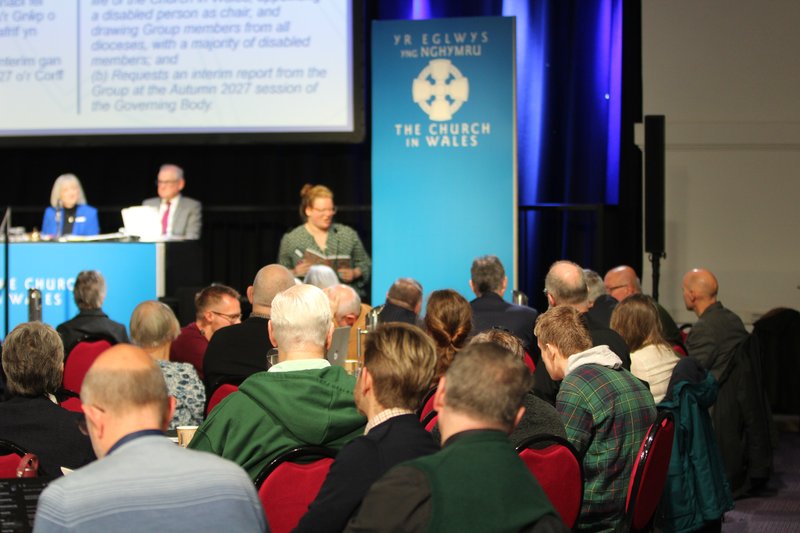
Private Members’ motion on disability
Dr Hurrell introduced her motion which called for the formation of a Disability Welcome Delivery Group to advise on engaging with disabled people in the life of the Church. Dr Hurrell said her adult daughter used a wheelchair and had learning difficulties. Her daughter had been “thoroughly welcomed and included” in church, and there was much good work to be built on in the Church. But there were some “horror stories” too, such as churches without accessible toilets or too many steps. The law only required older buildings to make “reasonable adjustments”, which in some cases meant nothing at all. But churches must be places of welcome for all, regardless of secular law, Dr Hurrell argued. Too often disabled people were forced to apologise for themselves or fight for their rights again and again.
If the welcome group was set up, it would be chaired by a disabled person and have a majority of disabled members, although the definition of disability remained broad, she explained. It could develop resources and share ideas with provincial and diocesan staff. She knew some in the Church feared it lacked the resources to retrofit its plethora of old buildings, many of which needed funds already for leaking roofs or crumbling walls. But progress could be made simply by being more intentional about welcome: “Don’t let the perfect be the enemy of the good.
Seconding the motion, Ms Dale said a good welcome had to mean more than kind words at the door. Too often disabled people were being wedged into the aisle or stuck at the back of church. Kind words meant little if disabled people were being made to feel they did not fit in. One in five Welsh people had a disability, after all. “If it is not accessible, it is not church.”
Nicholas Cooke (Monmouth) supported the motion, but said it would require “great skill and engagement” to achieve changes which worked around secular law on listed buildings. None of this would “come on the cheap”, but it was necessary.
Angela Treherne (Llandaff) highlighted the problem of finding enough funding for implementing accessibility changes, sharing the challenges her own church had faced. It was vital the resources were in place to implement the motion if passed.
Helen Hayes (St Asaph) asked how those with disabilities could also be encouraged into ministry.
Mr Davis, who mentioned he has invisible disabilities, said the issue should be a standing item on a larger committee rather than siloed into a one-off group.
Speaking in Welsh, Dr Cynan Llwyd, (Guest) General Secretary of Cytun, contributed. He mentioned the representation of the different denominations in the Governing Body, and noted that all the denominations are addressing this problem. He encouraged the members to work together to learn from each other and share good practice. He also asked how our digital strategy could be expanded to include disabled people, both in person but also on digital platforms.
Ms Oxenham said accessibility did not always mean costly renovations to listed buildings, but could also be simple things like tweaking liturgies or producing resources in different formats.
Mr Wood said welcome meant more than just accessing Sunday worship and asked how disabled people could be included in home groups or even GB.
Ms Rowan said the group’s recommendations must be actionable and not simply empty words. She also urged non-disabled people to play their part rather than leaving disabled people to carry all of the load.
Robert Charlton (Swansea and Brecon) welcomed the motion, describing it as “overdue”. His wife was deaf and relied entirely on hearing loops to engage in worship. Could the group produce a report quicker, by next spring rather than the autumn?
Dr Payne recommended an audit tool from the disability charity Through the Roof, and also raised a plea from a disabled friend who couldn’t attend the GB due to mobility issues and wondered if it could meet in a hybrid way on Zoom again.
Canon Justin Davies (co-opted) pointed members to a training course on disability inclusion being offered by St Padarn’s.
The motion was passed unanimously.
Session Six
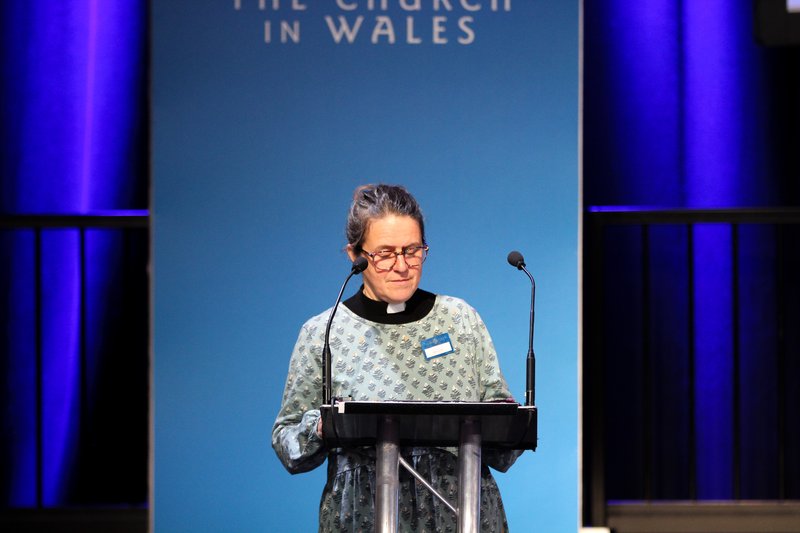
Questions
Carrie White (Bangor) asked how decisions of the GB were communicated to those affected by them. In response, Mr Llewellyn from the RB noted proceedings were livestreamed and available on YouTube, as well as the Highlights document. But there was room for more communication, he agreed, and so a new Governing Body at a Glance document will be produced as soon as possible after each meeting and published on the Church’s website.
Dr Hurrell asked if the Church could match the Church of England’s more generous maternity pay policy to better support younger clergy and their families. In response, Bishop Gregory – the deputy chair of the RB’s HR committee – said clergy currently received full stipend for 18 weeks, followed by statutory maternity pay for an additional 20 weeks on top (as long as they had been in stipendiary service in Wales for at least 12 months). This went much further than the statutory entitlement of six weeks full pay, and any changes would require the GB’s approval, he added.
It was true that the C of E recommended dioceses pay 26 weeks full pay, and some even covered 39 weeks. It was possible for any individual diocese to enhance maternity pay locally, but the HR committee was open to discussing expanding policies province-wide (although any extra costs would be borne by the dioceses). This may also have consequences for the RB’s own employees’ maternity policies.
Dr Ellis asked when the membership app would give the opportunity to enter data in both Welsh and English. James Rodaway, director of IT for the RB, said his team was close to releasing a Welsh version of the app.
Dr Payne asked the bishops to disseminate across the Church the work of the Anglican Communion’s Science Commission, due to report its progress at the upcoming Belfast gathering of the Anglican Consultative Council. In response, Archbishop Cherry quoted a call from 40 global faith leaders in 2021 about integrating faith and science “to know more and to care more”. Dr Payne was one of the Communion’s science commissioners and was sharing things the Church in Wales had learned across the global Communion. She urged members who wished to join this work to speak with Dr Payne.
The final question came from Mr Dearden, who asked if the liturgical calendar could be changed so that if St David’s Day fell on a Sunday in Lent it could still be celebrated rather than being moved to another day. Bishop Gregory said while the weekly commemoration of the resurrection on Sunday has traditionally taken precedence over saints’ days, minor variations like this could be accommodated.
Net zero update
Canon Justin Davies introduced an update on the Church’s journey towards net zero carbon emissions, triggered by a 2021 GB motion, before handing over to Archdeacon Clavier, who had been providing a theological underpinning to the work. He reflected on Mary’s encounter with the resurrected Jesus, the “good gardener” of the new creation and of our hearts. Humans too, beginning with Adam, were also created to be “God’s gardeners” – this should be at the heart of being the Church, he argued. Our too “comfortable” Western Church had been partly responsible for the destruction of God’s creation through excessive emissions, and so it was up to that same Church to bear the cost on behalf of the majority world to fix it.
Julia Edwards, director of climate change at the RB, then showed members a video sharing progress towards net zero across churches in Wales. She urged more churches to sign up to A Rocha’s EcoChurch programme, pointing to “phenomenal growth” in this area (40% of churches were now registered).
Alex Glanville, director of property strategy at the RB, took over to explain about a new £600,000 fund for grants to churches for net zero projects. Moves to replace oil boilers with heat pumps in parsonages was also underway, and some dioceses were also moving ahead with solar panel installations. With the Caring for God’s Acre charity, the Church was running a two-year lottery-funded pilot project to encourage more biodiversity in churchyards. Canon Davies ended the presentation in prayer, thanking God for creation and asking for his help in conserving it.
The Revd John Harvey (Bangor) said EcoChurch was an “easy win”, both for churches to work towards net zero but also in local outreach. He said Christians should also be aware of which political parties in the Senedd were sceptical of cutting emissions.
Ms Brooker warned money in her ministry area to look after churchyards was very limited, and that “rewilding” paradoxically needed active management.
Dean Ian echoed warnings that some political parties denied the urgency of climate change, and urged the Church to declare publicly that this was “not a fairytale”.
Archdeacon Andy asked if the Church could enable clergy to sign up to the cycle to work scheme, to benefit their own physical and mental health and cut emissions.
Report of the Standing Committee
Mr Llewellyn, chair of the standing committee, presented their report, as well as an additional report from the representation of women working group. Members then voted through two recommendations for appointments from the report before debating the overall report.
Ms Prince asked for the age-limit to lay diocesan posts to be reconsidered, noting her 80-year-old and very capable lay ministry area chair was barred from diocesan conference.
Caroline Woollard (Monmouth) was saddened to still be discussing gender inclusion in ministry, noting the overall balance masked the preponderance of men in stipendiary roles. “We must not be here still talking about this in another 20 years.”
Mr Mullins echoed the call to reconsider the 75-year-old age limit.
Dr Hurrell asked if a report into women’s experiences at St Padarn’s could be published.
Archdeacon Stella was concerned about the pipeline of women clergy into senior leadership roles, noting only three of the Church’s 18 archdeacons were female. Only a quarter of the clergy on GB were women too, she said. How can the Church address the unconscious bias clearly present here?
Ms Rowan warned younger women were not being supported properly as they went through training, but questioned why the existence of traditionalist theological opposition to women’s ordination was named in the report as another barrier when this was not, in her experience, a problem.
Archdeacon Clavier said there was something wrong with how white the GB was too.
Ms Dale said finding childcare while training at St Padarn’s as a single parent and living in North Wales was almost impossible, and blocking talented women from coming forward.
Mr Llewellyn encouraged those frustrated by the age limit to bring forward private members’ motions to change it.
Bishop Mary added that it was sad to still be monitoring gender representation, and agreed with Archdeacon Clavier that other aspects of inclusion also needed attention.
Members then voted to approve the report, and also approved without debate the standing committee’s report on governance and legal matters.
Bench of Bishops report
Bishop Mary said the bishops sought to embody the values shared by Archbishop Cherry in her presidential address, to take responsibility and be prayerful and reflective, open to challenge and accountability while maintaining the unity of the Church.
There was no debate, and so Archbishop Cherry then took the chair to lead farewells, including to the former Archdeacon of Llandaff, Rod Green, who had been appointed Bishop of Stepney in the Diocese of London, and the former Archdeacon of Wrexham, Hayley Matthews, who had taken up a new role with the Church Army.