
 Safeguarding
 Find a church
 Find clergy
 Donate
Even birds and animals have much they could teach you; ask the creatures of earth and sea for their wisdom. All of them know that the LORD's hand made them. It is God who directs the lives of his creatures; everyone's life is in his powerJob 12 7-10
This learning journey draws mainly from two statements of what matters: ‘Our natural world is diverse and dynamic, influenced by processes and human actions’ and ‘Informed, self-aware citizens engage with the challenges and opportunities that face humanity, and are able to take considered and ethical action’. There are connections with other statements of what matters and with other Areas that can also be explored through this sub lens.
Sub lens guidance
Care Concern and Respect
Early Stages
Learners can:
- begin to show care and respect for the natural world and living things around them.
- start to understand the link between creation and caring for God’s world.
Further Along
Learners can:
- identify how and why they and others show care, concern and respect, as well as considering religious and non-religious perspectives.
- start to further understand the concept of Christian stewardship and how it links to Jesus’ teachings.
Later
Learners can:
- raise, and consider critically, ethical questions related to human activity, nature and place, engaging with religious and non-religious responses, as well as with their own responses.
- start to engage with religious theories.
Awe and Wonder
Early Stages
Learners can:
- begin to experience awe and wonder in nature, which develops as they explore the world around them, observing and asking questions.
- start to develop reflection skills through a range of outdoor experiences.
- start to identify what is beautiful to them and why.
Further Along
Learners can:
- develop a sense of the complexity of life and its interconnectedness , as well as a sense of active responsibility.
- start to link spirituality with beauty and the way it makes them feel.
Later
Learners can:
- have experiences of awe and wonder which are nuanced by deeper and more wide-ranging engagement with others and with place, as well as with the natural world and living things.
- explain why they find something beautiful, how it makes them feel and how they link that to their personal spiritual development.
Responsibility and Action
Early Stages
Learners can:
- begin to show an awareness of the variety of living things beyond themselves, and that their actions can impact these.
Further Along
Learners can:
- come to know religious and non-religious ‘stories’ about local places, the natural world and living things, and how these relate to themselves and others.
- through religious and non-religious narratives (e.g., about the origins of the world), learners can learn about different philosophies important to our understanding of the world and the place of humans within it.
- through the interrogation of biblical narratives learn about the Christian understanding of the world and the place of humans within it.
Later
Learners can:
- recognise how values and beliefs are reflected in action, from religious and non-religious perspectives, and how these relate to their own experiences.
- learn about the Christian understanding of the world and the place of humans within it, through the interrogation of biblical narratives.
- Through the critical analysis of biblical narratives learn about the Christian understanding of the world and the place of humans within it.
- show an understanding of why Christian’s challenge social injustice and how this is done locally and globally.
- discuss the concepts of free will, determinism including and moral responsibility.
Place and Space
Early Stages
Learners can:
- begin to recognise that they are located in place and space, and that this has meaning for them.
- become familiar with their local church and why it is special to Christians.
Further Along
Learners can:
- recognise that places and spaces around them mean different things to different people, as well as considering places of special significance for religious or non-religious reasons.
- understand why people journey to special places.
- identify how places of worship support and enhance the community.
- become familiar with their Cathedral as a Christian Mother Church.
Later
Learners can:
- identify and explain various contested places (religious and non-religious), appreciating sensitivities surrounding place.
- start to examine migration in relation to religion and the dispersal of religious groups throughout Wales and the world.
- understand the complexity of debates and of influences such as, identity, authority, values, ethics and considerations of meaning and purpose in life.
Exemplar Approaches
This section gives examples of ways in which a pluralistic learning journey might be developed. The journey could start at any stage and should not be restricted to the examples given. Questions are encouraged to allow learner influenced development.
Each example relates to a specific phase of development but should be adapted to suit learners.
Early Stages
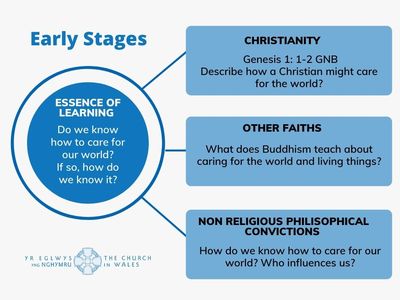
Describe how a Christian might care for the world.
Whose job is it to care for our world?
In the beginning, when God created the universe, the earth was formless and desolate. The raging ocean that covered everything was engulfed in total darkness, and the Spirit of God was moving over the water. Genesis 1: 1-2 GNB
What does Buddhism teach about caring for the world and living things?
Share the story of Siddharta (The Buddha) and the swan. Explore this in relation to the Christian perspective.
How did Siddharta know how to care for the swan? Talk about how Siddharta responded to his cousin’s selfishness.
How do we know how to care for our world? Who influences us?
Share a non-religious story about our world such as ‘Here we are’ by Oliver Jeffers. How is this similar/different to the Christian and Buddhist perspectives?
Further Along
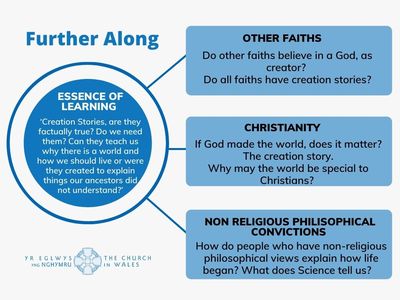
Do other faiths believe in a God, as creator? Do all faiths have creation stories?
Creation stories are found in Jewish, Sikh, Hindu, and Islamic traditions.
These stories often disagree about how and when creation happened, but they all tell us that a God was behind the scenes. Unpack the stories.
- Are the stories biased?
- Who are the characters in the stories?
- What themes are introduced and how do you interpret the stories?
Explore what it tells you about other religions and stewardship.
Discuss this quote in relation to the current crisis facing our planet:
Whoever plants a tree and diligently looks after it until it matures and bears fruit is rewarded. Prophet Muhammad
Other faiths face the same problems but do their view of stewardship of the planet differ according to faith? The Francis of Assisi Declarations (five leaders of the five major world religions – Buddhism, Christianity, Hinduism, Islam and Judaism – were invited to come and discuss how their faiths could and should help save the natural world)…
Discuss the quote:
The Earth has enough resources for our need but not for our greed. Mahatma Gandhi
If God made the world, does it matter? The creation Story. Why may the world be special to Christians?
The creation Story – is the Bible factually correct. The word of God.
The LORD God took the man and put him in the garden of Eden to work it and keep it. Genesis 2:15
- Is the story biased?
- Who are the characters in the creation story?
- What themes are introduced eg fall, covenant, redemption, stewardship and how do you interpret the story?
Unpack the story of Creation. Psalm 104
Genesis – how it begins and the clear links with Revelation and how it ends. Discuss Genesis 1:1 And Revelation 21:1
Discuss this quote in relation to the current crisis facing our planet:
And I brought you into a plentiful land to enjoy its fruits and its good things. But when you came in, you defiled my land and made my heritage an abomination. Jeremiah 2:7
Christians face the same problems so how should Christians treat the Earth?
Psalms 8 and 104 talk about the Lord creating the Earth and that Christians are its caretakers.
Do Christians have responsibility to the natural world or do they have the right to do as they wish and treat the planet’s resources as commodities? In Genesis Christians are told that they have dominion over creation rather than stewardship.
Discuss the quote
We fought apartheid. Now climate change is our global enemy. Desmond Tutu
How do people of non-religious philosophical views explain how life began? What does science tell us?
Science tells us what happened and how it happened but not the why.
- Why is the world special if nobody made it?
- Are the Creation stories biased?
Share a non-religious narrative such as the creation dilemma faced by the trolls in the Trolls Movie’ where different views are challenged.
Discuss and rewrite what it tells you about non-religious viewpoints and stewardship.
Discuss this quote in relation to the current crisis facing our planet:
We do not inherit the earth from our ancestors; we borrow it from our children. Anonymous
Does it make a difference if there is no Creator?
Discuss the quote:
The climate crisis has already been solved. We already have all the facts and solutions. All we have to do is to wake up and change. Greta Thunberg
Later
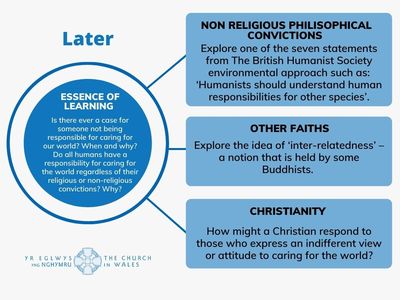
Do all humans have a responsibility for caring for the world regardless of their religious or non-religious convictions?
Explore a non-religious philosophical conviction perspective such as those of Humanists for a Better World (H4BW) who raise awareness of environmental, social and global issues.
Explore one of the seven statements from The British Humanist Society environmental approach such as: ‘
Humanists should understand human responsibilities for other species.
Consider if there is ever a case for someone not being responsible for caring for our world? If so, when and why this might be?
Explore the idea of ‘inter-relatedness’ – a notion that is held by some Buddhists.
This means that humans and nature need to live in harmony with one another in order for the world to flourish.
Share the Noble Eightfold path with learners – do any of these link to the idea of inter-relatedness and being responsible for taking care of the world? How?
Focus on ‘right mindfulness’ – how does this link with responsibility for caring for the world?
How might a Christian respond to those who express an indifferent view or attitude to caring for the world?
Many Christians believe that respect is at the heart of caring for God’s creation and as stewards, they must consider what they can do now to care for the world but also what they can do to ensure it continues to flourish in the future. What evidence can be found of this within the bible?