
 Safeguarding
 Find a church
 Find clergy
 Donate
There are some things that the LORD our God has kept secret; but he has revealed his Law, and we and our descendants are to obey it for everDeuteronomy 29:29
This learning journey draws mainly from two statements of what matters: ‘Events and human experiences are complex, and are perceived, interpreted and represented in different ways’ and ‘Human societies are complex and diverse, and shaped by human actions and beliefs’. There are connections with other statements of what matters and with other Areas that can also be explored through this sub lens.
Sub Lens Guidance
What makes people who they are?
Early Stages
Learners can:
- show an awareness of who they are and that they are similar and different from others
- show an awareness of faith identity and how this is similar or different for different faiths.
Further Along
Learners can:
- discuss what can form identity (e.g. relationships, lifestyles, beliefs, place) and how these influence people and their communities
- develop awareness of faith identity and how this is similar to or different from within Christianity and for different faiths.
Later
Learners can:
- review and evaluate a range of religious and non-religious philosophies, life stances, and practices concerned with what it means to be human, and then form and critically consider their own perspectives.
Communities, Contributions and Diversity
Early Stages
Learners can:
- begin to understand that they are part of various groups and communities and what belonging looks like
- show an awareness of diversity within relevant communities and that their experiences of belonging are similar to and different from others.
Further Along
Learners can:
- explore expressions of belonging in a range of religious and non-religious contexts.
- discuss the significance of belonging in people’s lives, including their own
- show an awareness of diversity within Christianity.
Later
Learners can:
- identify and evaluate relationships between belonging, commitment and contributions to society, culture and wellbeing and their faith journey.
Place, Time and Relationships
Early Stages
Learners can:
- begin to be aware that they exist in place and time, and this shapes them and the communities around them.
Further Along
Learners can:
- explore interactions between a range of communities and societies locally and more widely, and they can discuss the contributions of identity and belonging from religious and non-religious perspectives
- recognise continuity and change in identity and belonging, and how these are experienced personally and collectively.
Later
Learners can:
- investigate and evaluate relationships and interdependencies between a range of groups, communities, and societies (locally, nationally and globally) and how these impact on human life and the natural world
- critically consider the roles of identity and belonging in understanding and responding to shared contemporary issues from religious and non-religious perspectives.
Exemplar Approaches
This section gives examples of ways in which a pluralistic learning journey might be developed. The journey could start at any stage and should not be restricted to the examples given. Questions are encouraged to allow learner influenced development.
Each example relates to a specific phase of development but should be adapted to suit learners.

Early Stages
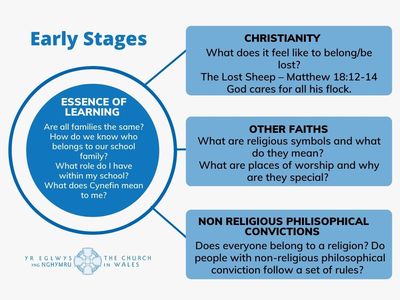
What does it feel like to belong/be lost? The Lost Sheep – Matthew 18:12-14
God cares for all his flock.
Are there rules for how Christians might treat other people?
- Ten Commandments (Exodus 20:1–17)
- The parable of the Good Samaritan (Luke 10:25–37)
- The Parable of the Prodigal Son (Luke 15: 11-32)
How do some Christians show that they belong to each other? Discuss friendships, engagement, weddings, christenings, Holy Communion.
- How do many Christians show that they belong to a larger family?
- Why is the Church an important building to some Christians?
What are religious symbols and what do they mean? What are places of worship and why are they special?
What are religious symbols and what do they mean? Look at symbols which show belonging to other faiths – Judaism, Buddhism, Sikhism.
What are places of worship and why are they special? – Judaism, Buddhism, Sikhism.
Where do Sikhs worship?
Many Sikhs choose to worship in a Gurdwara. What do they look like inside? Where is nearest Gurdwara to us?
Where do people from other faiths find their rules to follow?
- Siddhartha and the Swan – Buddhism
- Story of the Monkey – Buddhism
- Why do we celebrate Diwali? – Hinduism
- The Prophet and the Ants – Islam
- The Milk & The Jasmine Flower and the story of Duni Chand & the Silver Needle - Sikhism
All these stories are available in animation film on:
Does everyone belong to a religion? Do people with non-religious philosophical conviction follow a set of rules?
- What does it feel like to belong to a community with non-religious philosophical views? Are there special places or symbols?
- How do we know that we belong to a global community?
- How do I know people with non-religious philosophical convictions will treat people with respect?
Further Along
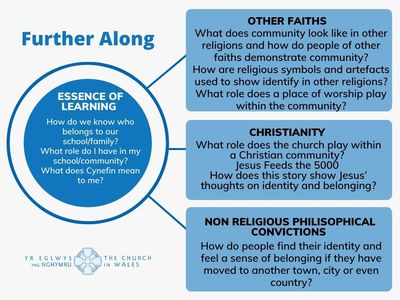
What does community look like in other religions and how to people of other faiths demonstrate community? How are religious symbols and artefacts used to show identify in other religions? What role does a place of worship play within the community?
What shows belonging in Judaism?
Bar and Bat Mitzvah are key celebrations in the Jewish faith. How do these celebrations demonstrate Jewish identity and symbolise belonging?
What are the 5 Ks of Khalsa?
The Sikh community is known as the Khalsa which means ‘Community of the Pure’.
What are mala beads/prayer bead? How are they used? Which religions use them? How are these used to create a sense of identity and belonging?
What role does the church play within a Christian community? Jesus Feeds the 5000 (Matthew 14:13-21) – How does this story show Jesus’ thoughts on identity and belonging?
- What is a community?
- What is a Christian community?
Community is very important to Christians, ‘Thou shalt love thy neighbour as thyself’.
Gospel of Matthew. How do Christians demonstrate this behaviour and attitude in their daily lives?
In a changing society what are the challenges of belonging to a Christian faith?
How do people find their identity and feel a sense of belonging if they have moved to another town, city or even country?
What is identity and belonging? What do these words mean?
What do people with non-religious philosophical convictions do to show belonging? (Routines, rituals, symbols, clothing )
What buildings and places may be special to people who hold non religious philosophical convictions? They can often be linked to what people value such as wellbeing, health, education, community and friendship. Can you think of some examples of places that people may identify as special? Examples might include: a park, a leisure center, a school, the Senedd.
Many humanists value places that support human beings to learn, to stay healthy, to meet people, to enjoy hobbies and interests, and to create a fair society. They believe that these buildings can help to illustrate some of the ways human beings have worked together to build a better world
- What places do you find special and why?
- Are all identities good ones? Can a person change their identity?
- How do people with non-religious philosophical convictions demonstrate a sense of community?
- Do people with non-religious philosophical convictions get married or have different type of ceremony?
Later
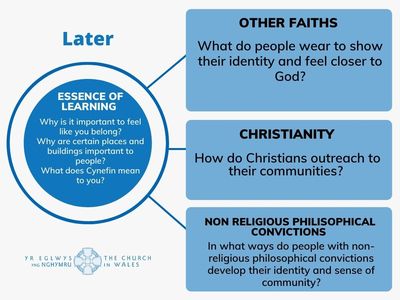
What do people wear to show their identity and feel closer to God?
Judaism
- What is a covenant?
- What are the Abrahamic covenants with God?
- Why is Israel an important place to Jews?
- What symbols are there in Judaism and why are they important?
- What do Jews wear to show their identity and feel closer to God?
- Do we need religious clothing to feel closer to God?
Islam
- What is the Ummah in Islam?
- What role does the Mosque take to serve the Muslim community?
- How do the five pillars show Muslim identity? How are these realised in today's society?
- Evaluation: Do you need to follow all five Pillars to be a Muslim?
What are the benefits and challenges of wearing religious symbols or clothing?
How do Christians outreach to their communities?
- Why is belonging to a community important?
- What makes a Christian community? – different denominations
- Is it a duty for Christians to care for those in their community?
Bible stories – Jesus heals the lame (emphasis on the friends helping the man who cannot walk). How can we be like those friends?
Good Samaritan – Is it always possible to follow the lead of the good Samaritan?
How do Christians outreach to their communities? – the role of a church in the community e.g. food banks/soup kitchens.
Evaluation: Is it the Church’s responsibility to care for the community?
Is it always easy to be a Christian in the 21st century?
In what ways people with non-religious philosophical convictions develop their identity and sense of community?
Consider opinions as to what makes us human? Physicalism Vs Dualism
- How do those with non-religious philosophical convictions know they belong somewhere?
- Explore in what ways people with non-religious philosophical convictions develop their identity and sense of community?
- What is the Humanist Building? How does it serve the community and show identity?
- How might someone prepare to emigrate to a different country? What difficulties might someone face emigrating to another country?