
 Safeguarding
 Find a church
 Find clergy
 Donate
Love the Lord your God with all your heart, with all your soul, and with all your mind.’ This is the greatest and the most important commandment. The second most important commandment is like it: ‘Love your neighbour as you love yourself.’ The whole Law of Moses and the teachings of the prophets depend on these two commandmentsMatthew 22: 37-40
This learning journey draws mainly from two statements of what matters: ‘Events and human experiences are complex, and are perceived, interpreted and represented in different ways’ and ‘Informed, self-aware citizens engage with the challenges and opportunities that face humanity, and are able to take considered and ethical action’. There are connections with other statements of what matters and with other Areas that can also be explored through this sub lens.
Sub Lens Guidance
What people value
Early Stages
Learners can:
- begin to identify what is of value to them (e.g., fairness, trust, love, life and kindness) and they listen to the opinions of others
- recognise the need to respect others and show what this looks like in their everyday lives
- identify Christian gospel values and start to explore teachings.
Further Along
Learners can:
- become aware of different interpretations and expressions of common values, appreciating a variety of religious and non-religious influences
- learn how some values and rights have changed over time
- discuss a variety of religious and non-religious perspectives on instances of inequality and injustice, as well as the challenges of identifying and protecting human rights
- identify Christian values and describe what this looks like in action.
Later
Learners can:
- increasingly be able to form, defend and review their ethical positions on matters of religious and non-religious significance (e.g. the sanctity of life, freedom of speech, animal welfare, veganism and the Just War Theory)
- explore the concepts of tolerance/acceptance/empathy
- appreciate variety of values of different religions and non-religions
- identify Christian values and how these impacts on their lives and others’ life.
Beliefs, Actions and Consequences
Early Stages
Learners can:
- begin to show an understanding of ‘right’ and ‘wrong’ and how their actions and feelings relate to this.
- begin to show an understanding of Christian values and their associated biblical teachings.
Further Along
Learners can:
- with increasing breadth and sophistication, explain how their own actions may have consequences for themselves and others, and for the world and living things, drawing on insights from a variety of religious and non-religious philosophical convictions.
- show an understanding of Christian concept of the fall.
Later
Learners can:
- postulate and evaluate the factors that influence pupil attitudes, behaviours and actions, as well as those of others, including factors relating to religious and non-religious beliefs and practices
- discuss the role of conscience in making moral decisions
- explore the concept of free will
- explore the concept of Karma
- show an understanding of the different Christian concepts of the fall.
Decision Making
Early Stages
Learners can:
- begin to recognise basic moral dilemmas and offer solutions.
- start to relate solutions to biblical or faith teachings.
Further Along
Learners can:
- learn rules and codes of behaviour (both religious and non-religious) relevant to them and to others around them and explain their impact on people’s lives
- understand guidelines for Christians such as commandments
- explain how Jesus’ teaching influences behaviour and decision making, for example, an eye for an eye; turn the other cheek; love our enemies; forgiveness.
Later
Learners can:
- identify and critically discuss the responsibilities and challenges of decision-making, showing understanding of relevant leaders/figures, processes and institutions that form part of decision-making, in both religious and non-religious contexts
- understand guidelines for Christians such as the Ten Commandments and how have these influenced our laws
- identify opportunities where appropriate moral action is needed in their communities/Cynefin/Diocese/Wales and the wider world.
Exemplar Approaches
This section gives examples of ways in which a pluralistic learning journey might be developed. The journey could start at any stage and should not be restricted to the examples given. Questions are encouraged to allow learner led development.
Each example relates to a specific phase of development but should be adapted to suit learners.
Further Along
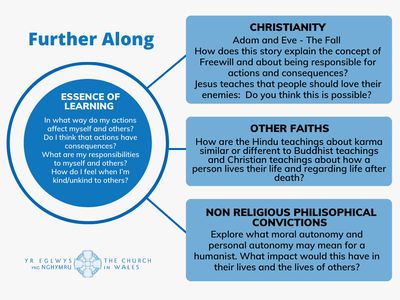
Adam and Eve and The Fall. How does this story explain the concept of Freewill and about being responsible for actions and their consequences? Jesus teaches that people should love their enemies: Do you think this is possible?
This approach offers an opportunity to explore that some Christians believe this story of Adam and Eve literally while other Christians do not.
Genesis 3 Adam and Eve and The Fall.
- What is Freewill?
- What are the Christian teachings about Freewill?
- What does having a conscience mean?
- How should having a conscience impact on Christians' actions and their consequences?
Link this to the story of the Good Samaritan in Luke 10:25 – 37 (The Jewish people and the Samaritans hated each other)
- How does this concept link with the Jesus’ great commandment of ’love your neighbour as yourself’ - treating others as you want to be treated’? Matthew 22:37
- Have Christians a responsibility to follow this commandment?
- How should this impact on Christians actions towards others?
- What are the consequences of good/bad actions within Christianity, in this life and the next?
How are the Hindu teachings about karma similar or different to Buddhist teachings and Christian teachings about how a person lives their life and regarding life after death?
Judaism – Leviticus 24:17 - 21 - ‘an eye of an eye a tooth for a tooth for a tooth’
- What do you think this means?
- What do you think are the consequences of following this statement?
- How does this relate to Jesus’ view of retaliation? Matthew 5:38 - 42?
Hinduism - Gandhi said ‘an eye for an eye will make the whole world blind’ what do you think this means and how would it impact on a Hindu’s life?
Buddhism teaches that people/things are interconnected:
- What does the concept of interconnectedness mean?
- How should this influence the actions of Buddhists?
Buddhist believe in the concept of karma - the idea that actions have consequences whether good/bad/neutral, in this life and the next.
- How similar or different are Buddhist teachings about karma to Christian teachings regarding actions and consequences?
- How are Buddhist teachings about karma similar or different to Christian teachings regarding life after death?
Hinduism also believes in the concept of karma; Hindu’s believe that one’s actions have consequences in this life and the next.
Explore what Moral autonomy and Personal autonomy may means for a humanist. What impact would this have in their lives and the lives of others?
Humanism in six words: Think for yourself, act for everyone.
- On what do humanists base their ethical decisions?
- What are the differences or similarities between Humanism’s view on the Golden Rule compared to Christianity and other World Faiths?
Humanists believe that our actions have consequences, to our ancestors and descendants, to human history, to the natural world:
- What does this mean to humanists?
- How would this be shown in their lives?
Although they do not believe in an afterlife, humanists believe something of us can, in a sense, survive our deaths: our atoms, genes, shared ideas, and contributions to wider society can outlive us.
- Explain what this means?
- How would this impact on a humanist life?