
 Safeguarding
 Find a church
 Find clergy
 Donate
I alone know the plans I have for you, plans to bring you prosperity and not disaster, plans to bring about the future you hope for.Jeremiah 29:11
This learning journey draws mainly from two statements of what matters: ‘Events and human experiences are complex, and are perceived, interpreted and represented in different ways’ and ‘Human societies are complex and diverse, and shaped by human actions and beliefs’. There are connections with other statements of what matters and with other Areas that can also be explored through this sub lens.
Sub Lens Guidance
Meaning, Purpose and Influence
Early Stages
Learners can:
- begin to recognise that people have personal life stories
- begin start to tell their own life story.
- begin to recognise what makes people special
- begin to recognise the meaning of different values
- begin to recognise how people are different, and to celebrate this uniqueness
- begin to retell the parables and recognise the core values in Jesus’ teachings.
Further Along
Learners can:
- explore a variety of paths through life that people have experienced, drawing on religious and non-religious contexts and influences. They can come to identify connections with meaning-making and purpose
- develop understanding of the deeper meanings of beliefs and values, and the role they play in giving meaning and purpose to people’s lives
- explore the meanings of parables and how they are significant in teaching values
- explore people’s rights and responsibilities to themselves, others, and the wider world
- explore the rewards and consequences or choices have.
Later
Learners can:
- analyse and critically consider the concept of vocation in the past and present from religious and non-religious perspectives
- examine challenges encountered in people’s life trajectories and evaluate religious and non-religious responses
- investigate why and how people are called to God
- discuss and explore how values can influence people’s decisions, and ethical beliefs, throughout their lives
- analyse how people justify their actions through their values and beliefs.
- compare parables, with current experiences
- reflect upon the impact that rights and responsibilities have to different people, and how others influence our decisions.
Life Stages and Events
Early Stages
Learners can:
- learners begin to be aware that they grow and change over time
- experience and compare how their own and other people’s growth is acknowledged and celebrated
- show how their lives are connected to special times and seasons
- begin to understand and identify events in spiritual life such as baptism
- begin to understand special times for Christians.
Further Along
Learners can:
- explore significant life events and rites of passage
- discuss the roles that these play in people’s lives by drawing on religious and non-religious insights
- identify sacraments and understand why people choose to take part in them.
Later
Learners can:
- analyse and critically discuss human ritual action in the marking of significant events and time.
- come to evaluate relevant philosophies of time from religious and non-religious perspectives and demonstrate how these may impact beliefs, practices and actions.
- Sacraments
- Life after death
- Ethical and moral issues – euthanasia.
Physical and Spiritual Journeying
Early Stages
Learners can:
- recognise that they go on many different journeys for various reasons
- show interest in the journeys of other people and can see how they are similar and different from their own experiences
- aware that journeys have physical features as well as non-material features
- identify journeys in the bible; such as Mary and Joseph
- recognise the meaning of having a home and a sense of belonging – ‘cynefin’
- develop an awareness of the world around them.
Further Along
Learners can:
- explore people’s experiences of important journeys from religious and non-religious perspectives, and they can identify reasons for these journeys
- understand that journeys are connected to place and time
- imagine what an important journey might look like in their own lives
- understand the concept of Christian pilgrimage
- understand why people made important journeys in the Bible e,g, Moses
- explore and identify the meaning of ‘cynefin’ and refuge.
Later
Learners can:
- identify and evaluate relationships between physical and spiritual journeys and their effects on the lives of individuals, communities and wider society (e.g. identity, human formation, diversity, culture)
- critically consider the interconnectedness of journeys, landscapes and people across place and time, drawing on religious and non-religious contexts
- critically analyse why people have to find refuge in other places.
Exemplar Approaches
This section gives examples of ways in which a pluralistic learning journey might be developed. The journey could start at any stage and should not be restricted to the examples given. Questions are encouraged to allow learner influenced development.
Each example relates to a specific phase of development but should be adapted to suit learners.
Further Along
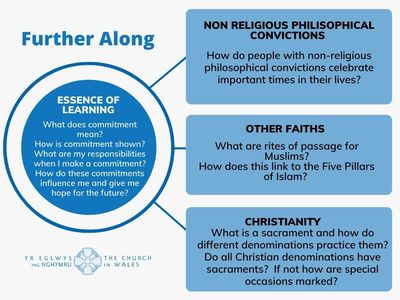
How do people of non-religious philosophical convictions celebrate important times in their lives?
How do people of non-religious philosophical convictions show commitment throughout their lives?
Naming ceremonies, marriages, death…
How do humanists celebrate births? Why is this important to them?
Discuss what is the humanist view of ‘the good life’?
What do humanists believe happens in death? How is this similar or different to religious beliefs?
What are rites of passage for Muslims? How does this link to the Five Pillars of Islam?
How do people of other faiths show commitment throughout their lives?
What are rites of passage for Muslims?
Adhan, Aqeeqah, Hajj, Nikah (marriage)…
What is Aqeeqah? (welcoming)
What is a Bismillah ceremony?
How do Muslims show forgiveness?
- Everyone deserves forgiveness (Qur'an 64:14) O you who have believed, indeed, among your wives and your children are enemies to you, so beware of them. But if you pardon and overlook and forgive - then indeed, Allah is Forgiving and Merciful.
How does this link to the Five Pillars of Islam? Why are they important to Muslims?
- Shahadah, Salat, Zakat, Sawm, Hajj
What do Muslims believe happens in death?
What are rites of passage for Buddhists?
Initiation, Marriage, Dying, Death, Funeral.
What are the blessings of the Three Refuges?
What are the Four Noble Truths and how are Buddhists able to put the Noble Eightfold Path into practice? Why are they important to Buddhists?
Is forgiveness important to Buddhists?
What do Buddhists believe happens in death?
What is a sacrament and how do different denominations practice them? Do all Christian denominations have sacraments? If not how are special occasions marked?
How do some Christians show commitment throughout their lives?
What is baptism? (welcoming)
The Baptism of Jesus (Matthew 3:13-17)
Discuss what is a sin and how God forgives others. What is forgiveness and how many times should Christians show forgiveness?
- The Parable of the Unforgiving/Unmerciful Servant (Matthew 18:21-22)
- Baptism, Confirmation, First Holy Communion, marriage…
- Easter
Why do some Christians make their First Holy Communion?
The Last Supper of Christ – How is this symbolic to the Eucharist in Churches today?
Why do Christians believe Jesus died? Why is it important to Christians that Jesus rose again?
What do Christians believe happens in death?