
 Safeguarding
 Find a church
 Find clergy
 Donate
I alone know the plans I have for you, plans to bring you prosperity and not disaster, plans to bring about the future you hope for.Jeremiah 29:11
The learning journey for this lens has drawn mainly upon two statements of what matters: "Events and human experiences are complex, and are perceived, interpreted and represented in different ways" and "Human societies are complex and diverse, and shaped by human actions and beliefs." There are connections with other statements of what matters and with other areas of learning and experience that can also be explored through this lens.
Sub Lens Guidance
Deeper Questions of Life
Early Stages
Learners can:
- ask deeper questions about themselves and others, and about the natural world and living things around them (e.g. Who am I? Why do things die?), as well as listening to the opinions of others
- begin to ask deeper questions about creation and biblical teachings
- begin to link teachings from other faiths and non-religious worldviews.
Further Along
Learners can:
- gather and discuss religious and non-religious insights and consider their own and others’ opinions, viewpoints and interpretations with increasing sophistication
- start to consider the parallels between scientific views and creation
- explore big questions such as why are we here, what happens when we die
- develop their own big question in response to their learning.
Later
Learners can:
- understand that issues of truth, meaning, purpose and value can be debated and evaluated as learners engage more deeply with a range of challenging questions on these issues (e.g. the existence of good and evil, the nature of suffering, the use of wealth)
- understand examples from biblical teachings and draw comparisons from other faiths and non-religious philosophical convictions
- understand that responses to such questions are complex, as well as often partial and inconclusive
- understand viewpoints regarding free will and determinism from a Christian viewpoint as well as range of faith and non-religious philosophical convictions.
Influence, Continuity and Change
Early Stages
Learners can:
- begin to know and express what they like and dislike, what makes them happy and sad, and what their hopes and dreams are for the future, as well as responding to the ideas of others.
Further Along
Learners can:
- identify and discuss religious and non-religious insights concerning human feelings and needs, including what influences these and how they are expressed in their own and other people’s lives
- begin to understand how faith influences feelings and actions.
Later
Learners can:
- recognise both continuity and change in response to questions about meaning and purpose in life, both in their own lives society, culture and across time and place
- evaluate relevant contemporary values and ideas of self-worth from religious and non-religious perspectives
- recognise how faith, including the life and teaching of Jesus, influences self-worth.
Human Quests and Contributions
Early Stages
Learners can:
- begin to show an awareness of the people and the ‘big ideas’ that have shaped their local places and everyday lives
- begin to show an awareness of key people and big ideas in the Bible
- begin to show an awareness of how the life and teaching of Jesus influences our everyday lives.
Further Along
Learners can:
- imagine and discuss what they may contribute both now and in the future, and increasingly engage with the relationship between aspiration and practice, while considering a variety of contributions from religious and non-religious sources
- discuss how Jesus’ teachings may contribute to future choice and actions.
Later
Learners can:
- make increasingly complex connections among aspects of health and well-being, the needs and demands of the world today, and their own search for meaning and purpose
- explore religious imagery from around the world and begin to understand cultural difference.
Exemplar Approach
This section gives examples of ways in which a pluralistic learning journey might be developed. The journey could start at any stage and should not be restricted to the examples given. Questions are encouraged to allow learner influenced development.
Each example relates to a specific phase of development but should be adapted to suit learners.

Further Along
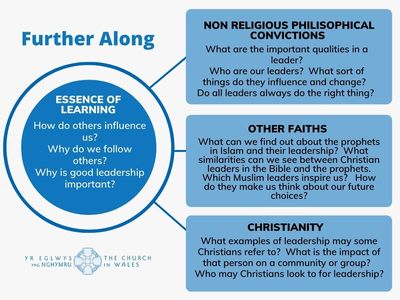
What are the important qualities in a leader? Who are our leaders? What sort of things do they influence and change? Do all leaders always do the right thing?
- What can we do when they don't do the right thing?
- How can we lead? Why do we follow?
Discuss the role of the Children’s Commissioner for Wales.
Look at their responsibility for protecting children rights and what that means to communities and children across Wales.
- Why is their role important?
- What sort of person makes a good commissioner?
- What do we do when we think our leaders are not doing the right thing?
What can we find out about the prophets in Islam and their leadership?
What example of leadership may some Muslims refer to?
The prophets - God and authority in Islam - GCSE Religious Studies Revision - Edexcel - BBC Bitesize
What similarities can we see between Christian leaders in the Bible and the prophets?
Examples may include:
- Ibrahim
- Isa
- Musa
- Dawud
What are the similarities to the leaders in the Bible that Christian may refer to?
Which Muslim leaders inspire us? How do they make us think about our future choices?
Leaders may choose to look at people such as Malala Yousafzai or Dr Hany El Banna.
What examples of leadership may some Christians may refer to?
What is the impact of that person on a community or group?
Look at the story of Moses in the Bible. Refer to extracts from Exodus.
Identify different key points in his life. Discuss the qualities that Moses showed in different situations. How did he influence change?
Did Moses always do the right thing? How did Moses know what he should do? Look at the story of the burning bush.
- Who may Christians look to for leadership?
- Which Christian leaders inspire us? How do they make us think about our future choices?
Learners may choose to look at current Christian leaders such as their local church leaders or their Bishop or alternatively leaders such as Archbishop Desmond Tutu or Martin Luther King Jr.