
 Safeguarding
 Find a church
 Find clergy
 Donate
“It is your responsibility to act. We are behind you, so go ahead and get it done.”Ezra 10:4
This learning journey draws mainly from two statements of what matters: ‘Our natural world is diverse and dynamic, influenced by processes and human actions’ and ‘Human societies are complex and diverse, and shaped by human actions and beliefs’. There are connections with other statements of what matters and with other Areas that can also be explored through this sub lens.
Sub Lens Guidance
How People Live Together
Early Stages
Learners can:
- understand that they have many different relationships
- think about what helps them live with others
- offer opinions about how disagreements can be resolved
- find out more about Christian’s relationship with God.
Further Along
Learners can:
- identify and discuss how the importance of relationships (personal, social, environmental, and transcendental) is expressed in people’s lives, drawing on religious and non-religious contexts
- discuss Trinity and the Christian relationship with the Holy Spirit.
Later
Learners can:
- recognsie that relationships are dynamic and complex.
- critically consider influences that can contribute to harmony and discord globally, locally and personally (including religious and non-religious influences).
- review and evaluate challenges presented by relationships, drawing on a range of religious and non-religious insights and experiences.
- recognise the difference in opinions between Christian groups and the challenges that may present.
Responsibilities and Interconnectedness
Early Stages
Learners can:
- begin to be aware of connections between their own lives and the lives of other people, the natural world and living things
- Begin to show responsibility towards others through simple actions
- begin to be aware of a connection with God (if appropriate to their beliefs).
Further Along
Learners can:
- identify how and why people show responsibility for people and places outside their personal relationships
- discuss important material and non-material dimensions of relationships (including spiritual, religious, moral)
- recognise connections with human growth and how people can live together responsibly in the world, as people, groups and societies.
- discuss their spiritual relationship with God.
Later
Learners can:
- develop critical appreciation of significant issues affecting relationships at a global level
- imagine possible futures
- critically engage with a range of religious and non-religious philosophies, exploring interconnectedness in life, as well as the nature and understanding of human beings within it.
Well-being, Identity and Inclusion
Early Stages
Learners can:
- be aware of their own experiences and feelings when they engage in activities with others
- recognise that other people have experiences and feelings too, which are different and similar to their own
- show curiosity about other people’s lives.
Further Along
Learners can:
- explore how action can involve significant commitment and sacrifice (past and present) and have major effects on the lives and wellbeing of others and the wider world
- recognise connections between actions and identity, including religious and non-religious influences
- identify unfairness and inequality in their own personal lives and in wider society and suggest appropriate challenges.
Later
Learners can:
- critically consider what healthy relationships may look like and their contributions to wellbeing, drawing on a range of religious and non-religious perspectives
- understand and evaluate relationships between personal identity and relevant group identity.
Exemplar Approach
This section gives examples of ways in which a pluralistic learning journey might be developed. The journey could start at any stage and should not be restricted to the examples given. Questions are encouraged to allow learner influenced development.
Each example relates to a specific phase of development but should be adapted to suit learners.
Further Along
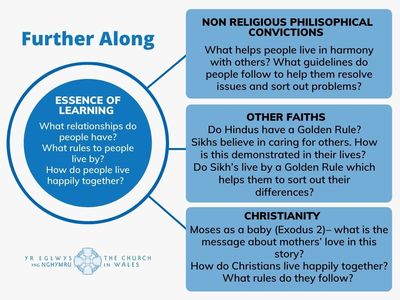
What relationships do people of non-religious and philosophical convictions have?
- How do they care for others?
- What helps them live in harmony with others?
- What guidelines do they follow to help them resolve issues and sort out problems?
What relationships do Hindu’s have with God/gods? How does this affect how they treat others in their daily life?
Do Hindus have a Golden Rule?
Sikhs believe in caring for others. How is this demonstrated in their lives? Discuss Guru Nanak’s (founder of Sikhism) belief in the importance of caring for all. Research, The Langar community kitchen of a Gurdwara.
Do Sikh’s live by a Golden Rule which helps them to sort out their differences?
What relationships are important to Christians?
Moses as a baby (Exodus 2)– what is the message about mothers’ love in this story?
How do Christians live happily together? What rules do they follow? – Jesus’ great commandment to love God and one another. (Golden Rule)
Discuss how Christians treat each other, including during difficult and challenging times. How do Christians deal with jealousy?
- Story of Joseph and his jealous brothers (Genesis).
- Christians see God as Father – see story The Prodigal Son. (Luke 15:11-32)
- Jesus also refers to God as Mother – see The verse of the hen. (Mathew 23:37/Luke13:34)
…How often have I longed to gather your children together, as a hen gathers her chicks under her wings … (reference to God as Mother)