
 Safeguarding
 Find a church
 Find clergy
 Donate
You are like light for the whole world. A city built on a hill cannot be hidden. No one lights a lamp and puts it under a bowl; instead he puts it on the lampstand, where it gives light for everyone in the house. In the same way your light must shine before people, so that they will see the good things you do and praise your Father in heaven.Matthew 5:14-16
This learning journey draws mainly from three statements of what matters: ‘Events and human experiences are complex, and are perceived, interpreted and represented in different way’, ‘Human societies are complex and diverse, and shaped by human actions and beliefs’, and ‘Informed, self-aware citizens engage with the challenges and opportunities that face humanity, and are able to take considered and ethical action’. There are connections with other statements of what matters and with other Areas that can also be explored through this sub lens.
Sub Lens Guidance
Authorities and Influences
Early Stages
Learners can:
- begin to recognise that they are influenced by some important people, and that this affects how they feel, think and behave
- begin to identify Christian leaders and their roles in church and faith communities
- begin to identify important people in the bible and how they influenced others.
Further Along
Learners can:
- discuss what can form identity (e.g. relationships, lifestyles, beliefs, place) and how these influence people and their communities
- identify and explore different sources of authority within religious and non-religious contexts (e.g. leaders, relationships, texts, codes of behaviour, traditions).
- understand that sources of authority influence people’s lives in a variety of ways
- understand the role of faith leaders within their community
- explore what ‘purpose’ or “calling” might mean to people of faith
- identify different types of leaders in the bible and how they influenced others
- discuss how Jesus influenced the lives of the people he met.
Later
Learners can:
- analyse and evaluate complex relationships that exist between and across sources of authority (including their own)
- critically consider the authority of religious and spiritual experience and conscience, in the past and present, and their impact on people, society and culture
- engage with religious leaders and bodies asking appropriate questions around their role/beliefs/faith journeys to further understanding
- Study places of worship in their cynefin and the role of their leader/officials.
Experiences and Interpretations
Early Stages
Learners can:
- begin to be aware of important influences in the lives of others, and that their experiences are similar and different from their own. are similar and different to others.
Further Along
Learners can:
- explore how sources of authority are interpreted in different ways by various people and groups, within religious and non-religious contexts
- recognise influences on interpretations and that some sources of authority carry more weight than others for different people, groups and societies
- Explore sources of authority in Christianity
- Understand how the bible is a source of authority for Christians and why
- Understand how different groups within Christianity interpret the bible differently.
Later
Learners can:
- draw on multiple sources of authority to evaluate religious and non-religious interpretations of issues relevant to the human condition, and they can present their own informed positions
- critically consider how and why experiences and concepts of authority may change over time.
Choices and Actions
Early Stages
Learners can:
- understand that their actions can be affected by choices
- show awareness of influences on their choices
- Show awareness of how Christians are guided by the teachings of Jesus.
Further Along
Learners can:
- come to recognise how people and communities draw on religious and non-religious sources of authority to guide them in their lives and to inform important decisions
- Understand how Christian communities draw on the bible to guide them
- Understand the role of the church leaders in supporting and guiding Christians.
Later
Learners can:
- use their knowledge and understanding of a range of sources of authority to engage critically in contemporary ethical issues or debates, and to influence possible actions and outcomes (e.g. challenge, consensus, reconciliation).
Exemplar Approach
This section gives examples of ways in which a pluralistic learning journey might be developed. The journey could start at any stage and should not be restricted to the examples given. Questions are encouraged to allow learner influenced development.
Each example relates to a specific phase of development but should be adapted to suit learners.
Further Along
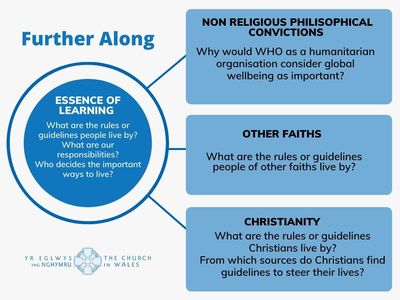
Why would WHO as a humanitarian organisation consider global wellbeing as important?
What rules or guidelines do people who are humanitarian live by?
The principles of humanity, neutrality, impartiality and independence are fundamental to humanitarian action.
Consider what was happening globally when the UN was formed and what impact has its work has had on the world today? What is the symbolism in the United Nations logo?
The United Nations came together to create rules for living. These included setting up a global health organisation known as the World Health Organisation. The World Health Organisation (WHO) defines health as 'a state of complete physical, mental and social wellbeing and not merely the absence of disease or infirmity'.
Discuss this statement and what it means. Evaluate why WHO as a humanitarian organisation would consider global wellbeing as important?
What are the rules or guidelines people of other faiths live by?
The Torah and the Tenakh are the main sources of wisdom and guidance which Jews reflect upon to improve their relationship with God and to live good lives.
The Tenakh is a sacred text in Judaism and is often referred to as the Hebrew Bible. It is known by Jews as the written law. The Torah is part of the Tenakh. Consider the significance of Shavuot - a celebration of the second covenant God made with all Jewish people at Mount Sinai. The Jewish relationship with God is a covenant relationship. Explore and interpret what is meant by this.
What special prayers are used in Judaism?
The Shema is a special prayer written in the Torah. Jewish people say the Shema every morning and evening to help them hear and talk to God.
Study the significance of the Shema to Judaism. A mezuzah holds the Shema on gates and door frames – why is this important and what does this symbolise?
What are the rules or guidelines Christians live by? From which sources do Christians find guidelines to steer their lives?
Some Christians seek guidance from the Bible and use it to deepen their personal relationship with God. For many Christians the relationship between humans and God is sometimes found described as being like that of a child and parent.
Which prayers are important to Christians and why?
‘Our Father who art in Heaven’, is the first line of the Christian, ‘Lord’s Prayer’. In Aramaic (the language Jesus spoke) ‘abba’ meaning ‘father’ is a way a child would speak only to their own “father”. The ‘Lord’s Prayer’ is in the New Testament of the Bible, within the gospels of Matthew and Luke.
How many different languages is the Lord’s Prayer spoken?
The Lord's prayer, taught by Jesus to his followers, is one of the most popular prayers used by many Christians across the world. It is spoken in many different languages.
Analyse the meaning of the ‘Lord’s Prayer’ how are the words of the prayer important for some Christians? Explain how a relationship with God might impact on how Christians may choose to live their lives.
What are our responsibilities?
The New Testament of the Bible explains to Christians how God eventually came to live among them - as Jesus so that He could teach people how to live responsibly.