Highlights - November 2025
Members of the Church in Wales’ Governing Body met for a special meeting on Tuesday, 25 November 2025 in Llandudno. The meeting was live-streamed and you can read the summary below.
Highlights
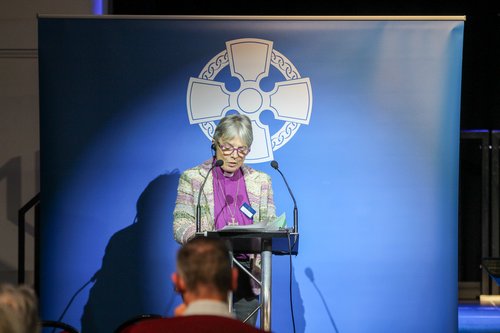
Plans to appoint an interim Bishop of Bangor to stabilise the diocese before making a permanent appointment were ratified by the Governing Body in a special meeting in Llandudno.
The Archbishop of Wales, the Most Revd Cherry Vann, began by thanking the more than 100 members of the GB who had been able to join the one-off session. Proposing the motion, Archbishop Vann said it aimed to provide a “long-term, sustainable and hopeful future for the Diocese of Bangor”. The electoral college in Bangor had decided it could not proceed with choosing a new bishop earlier in the autumn. The standing committee had rejected the usual fallback of the appointment being made by the bench of bishops, and feared simply running the normal electoral college a second time would produce the same result.
The third option was to find from outside Wales an interim bishop to serve for up to two years. “This is uncharted territory” for Wales, Archbishop Vann said, but there were precedents elsewhere, including currently in Liverpool.
An interim bishop had the same responsibilities as any bishops, except the role was time-limited. Archbishop Vann said she would welcome a proposed amendment to the motion which would set the limit to a month following the April 2028 meeting of the Governing Body.
The bishop would provide leadership for the Diocese of Bangor after it had gone through so much “trauma” in recent years, she concluded. “The Diocese of Bangor has significant challenges to address.” Along with a new permanent diocesan secretary who should be appointed in the next six months, the interim bishop would implement transparency and integrity at ever level.
She resisted another amendment, which sought to limit the appointment to someone aged under 70, but welcomed a third which called for a lessons-learned review.
The Revd Rhun ap Robert (Bangor) seconded the motion. Speaking in Welsh, he said this motion was “not just an organisational necessity, it is a thoughtful and strategic response to the unique challenges our diocese faces at this time.
He added that although the Electoral College had worked diligently, it is clear the time is not yet right to press ahead and elect the next Bishop of Bangor. Rushing to another Electoral Collage at once would risk repeating the same challenges as could lead to further uncertainty. Instead of that, this motion offers a better way forward, one which prioritises stability, prearation for the future and the long-term mission of the diocese. Crucially, the motion recognises the need for a clear
timetable, which avoids the risk of having no bishop for an indefinite period, and also allows enough time to regroup, to reflect and to prepare for the next chapter.
Chris Dearden (Bangor) said his diocese now felt like a “dysfunctional family”, making “yet more poor decisions” in the wake of rounds of negative media coverage. Bangor needed experienced leadership now, especially as there were so many clergy vacancies.
Barney Hawthorne (Llandaff) supported the motion, warning dirty laundry was being pushed under the carpet in the Church. The GB should grasp the wider issue of “corruption” in the Church to try to prevent further issues arising in the future. “Why are we not discussing these things? Are we too deferential? Are we not prepared to ask difficult questions?”
Canon Emlyn Cadwaladr Williams (Bangor) supported the motion. Speaking in Welsh, he cautioned that making Welsh an essential qualification for the interim appointment risked making the pool of possible candidates too small. He also wanted to stress that there was much good work taking place in the churches on Ynys Mon, as there had been for many years, both there and in the diocese as a whole.
The Revd Ruth Coombs (co-opted) asked if the interim bishop would have full authority given they would only be treated as an assistant bishop under the constitution.
The Revd Kevin Ellis (Bangor) reassured the GB that bread was broken and wine outpoured still in the Diocese of Bangor. “Good things are happening, we are doing what we have always done,” he said, although he still supported the motion. An interim bishop was a “recipe for good news, and had been broadly welcomed across the diocese, he reported.
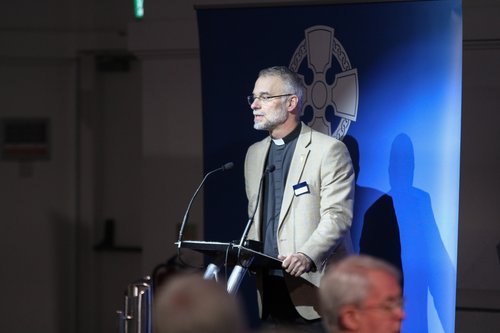
The Revd Dr Mark Clavier (Swansea and Brecon) said the need for the Church to be a “shining city upon a hill” had never been greater in an anxious, darkening age. But to shine brightly, “we must be seen to be faithful, trustworthy”. He backed the motion to signal to the world that the Church took things seriously and was changing. The vote was about more than Bangor, but the “credibility of our witness in Wales”.
The Archdeacon of Anglesey, the Ven John Harvey (Bangor), said his diocese remained an “inviting” place to minister in and reported appointments to vacancies were being made. He commended the motion.
The Revd Dr Sue Hurrell (co-opted) supported the motion, but questioned why the appointing decision was going from being a collective one by the college to a unilateral one by the archbishop.
The Archdeacon of Meirionnydd, the Ven Robert Townsend (Bangor), said the diocese had needed “time to breathe” after Andy John stood down as Bishop of Bangor. But the constitution did not allow for this, forcing an almost immediate process to appoint a new bishop. He said the rest of the diocese had looked on with horror at the news stories coming out of the cathedral as one person had sought to control everything in Bangor, allowing “chaos” to reign beneath them. The appointment of the sub-dean in 2021 created numerous conflicts of interest and blurred boundaries. People did try to question this, but only got responses which were “economical with the truth”, he told the GB. Those who pushed back were made very unpopular in the diocese. Appropriate governance fell by the wayside, Archdeacon Townsend said, but there are now senior figures “determined to put this right”. He welcomed the motion.
The Revd Richard Wood (Bangor) said he would abstain on the motion. The Church in Wales, not just Bangor, was effectively in special measures: “We are not a healthy thriving Church.” He was concerned the interim bishop would not have the time to make the “radical” changes needed, but would delay the necessary. He said a second attempt at the traditional electoral college process could well work now, but admitted his view was a minority one.
Mr Dearden then moved an amendment which would reimpose the normal constitutional age limit of 70 on the interim bishop, which he said was necessary to avoid setting a precedent.
The Dean of Newport, the Very Revd Ian Black (Monmouth), was initially sympathetic to the amendment but did not want to “box in” the Church from appointing the best person, even if they were 71.

The amendment was put to the vote and defeated.
Bob Evans (Monmouth) supported the motion, but asked for more clarity about the process of appointing the interim bishop – would the electoral college be consulted by the archbishop?
Sue Henley (St Davids) opposed the motion, which removed decision-making from the electoral college and handed it to the Archbishop alone. Why could the bench not make an appointment by themselves, in line with the constitution? She also wanted clarity on the status of the interim bishop, who will not sit on the bench but only a commissary of the Archbishop. Bangor needed to be surrounded with love by the rest of its church “family”, not condemned; many of its failings could be found in other dioceses. Bringing in an outsider as interim bishop could disrupt the work already underway to fix the problems, she warned.
Robert Charlton (Swansea and Brecon) moved his “small but important” amendment, which would push the end-date for the interim post to a month following the April 2028 meeting of the GB. This would avoid having to call a fresh
meeting of the GB if the term limit needed to be extended under the previous deadline of 1 January 2028.
The amendment was then passed by the GB.
Mr Dearden decided to withdraw his second proposed amendment.
In response, Archbishop Vann reassured members that the interim bishop would only be an assistant bishop in her Diocese of Monmouth for the purposes of voting in GB and remuneration. And that she would not appoint them unilaterally, but in consultation with the electoral college in Bangor. The process would begin the very next day if members passed the motion. “The interim bishop will have powers to do whatever radical work was required – they are not coming in to maintain the status quo while we get our act together,” she concluded.
The motion was passed 75-4, with 7 abstentions.